
Nai Khanom Tom: The Father of Muay Thai and His Legendary Ten Victories

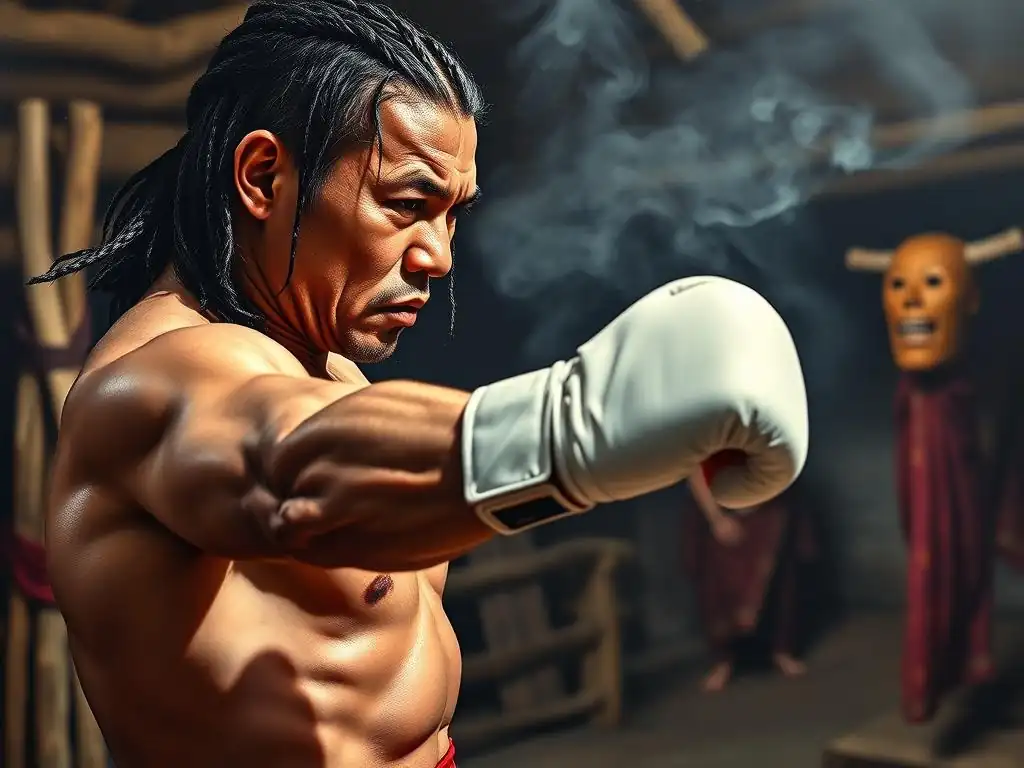
Welcome to Martial Arts Mastery!
Delve into the world of combat arts, where discipline meets history, and technique blends with philosophy. Ever wondered about the origins of Muay Thai and the legends that shaped its ferocity? Then prepare to be captivated by the story of Nai Khanom Tom, a name synonymous with the spirit of this ancient fighting style. Discover how this legendary figure, revered as the Father of Muay Thai, achieved ten consecutive victories against Burmese warriors, and the lasting impact his legacy has on the art of eight limbs. Ready to uncover the truth behind the legend? Let's begin.
- Introduction to Nai Khanom Tom: A Muay Thai Legend
- The Life and Times of Nai Khanom Tom
-
The Ten Unforgettable Victories: Nai Khanom Tom's Legendary Battles
- The Siamese Prisoner vs. Burmese Champions: A Display of Muay Thai Skill
- Victory 1: The Monk Fighter - A Battle of Wills
- Victory 2: The Royal Guard - A Test of Speed and Reflexes
- Victory 3: The Renowned Boxer - Outsmarting a Skilled Opponent
- Victory 4: The Aggressive Warrior - Utilizing Muay Thai Clinch Techniques
- Victory 5: The Strongman - Dominating with Elbow Strikes
- Victory 6: The Agile Fighter - Mastering Muay Thai Kicks
- Victory 7: The Defensive Expert - A Showcase of the Muay Thai Guard
- Victory 8: The Powerful Striker - Precision and Power in Every Strike
- Victory 9: The Strategist - A Masterful Approach to Combat
- Victory 10: The Grand Finale - The Final Triumph of Nai Khanom Tom
- Nai Khanom Tom's Fighting Style and Techniques
- The Cultural Impact of Nai Khanom Tom
- Nai Khanom Tom: Father of Muay Thai - A Lasting Inspiration
- Conclusion: The Unyielding Spirit of Nai Khanom Tom
-
Frequently Asked Questions
- What is Nai Khanom Tom best known for?
- Why is Nai Khanom Tom considered a significant figure in Muay Thai history?
- Where can I find more information about Nai Khanom Tom's life and battles?
- What kind of Muay Thai techniques might Nai Khanom Tom have used?
- How does the story of Nai Khanom Tom inspire modern Muay Thai practitioners?
- Final Reflection: The Enduring Legacy of Courage and Skill
- Unleash Your Inner Warrior: Start Your Muay Thai Journey Today!
Introduction to Nai Khanom Tom: A Muay Thai Legend
The Enduring Legacy of Nai Khanom Tom in Muay Thai History
The name Nai Khanom Tom resonates deeply within the history of Muay Thai, often revered as the "Father of Muay Thai." His story is more than just a historical footnote; it is a foundational myth that encapsulates the spirit, resilience, and technical prowess of this ancient martial art.
While precise historical records from that era can be sparse, the legend of Nai Khanom Tom's incredible feats in combat during captivity has been passed down through generations, solidifying his status as an unparalleled hero and a symbol of national pride for Thailand. His actions elevated the perception of Siamese boxing, demonstrating its effectiveness and artistry on a foreign stage under immense pressure.
This legendary figure's influence extends far beyond the 18th century. Every year, on March 17th, Thailand celebrates Nai Khanom Tom Day, a testament to his lasting impact. This day honors his legacy and serves as a reminder of the strength and effectiveness of traditional Nai Khanom Tom Muay Thai. His story inspires countless practitioners worldwide, emphasizing the importance of courage, skill, and the indomitable human spirit, qualities that remain central to the philosophy and training of Muay Thai today. The legend continues to drive the passion for Muay Thai, connecting modern fighters to their rich historical roots.
MartialArtsMastery.org Celebrates Southeast Asian Martial Arts Heroes
At MartialArtsMastery.org, we are dedicated to exploring the rich tapestry of martial arts from across the globe, and the fighting arts of Southeast Asia hold a particularly significant place. Legends like Nai Khanom Tom exemplify the depth, history, and effectiveness inherent in disciplines such as Muay Thai, Silat, and Kali. These arts are not merely fighting systems; they are cultural treasures, embodying centuries of tradition, philosophy, and practical combat wisdom. We aim to provide in-depth profiles of these heroes, understanding that their stories offer invaluable lessons for modern practitioners.
Profiling figures like Nai Khanom Tom allows us to delve into the historical context and evolution of martial arts. His story provides a window into the techniques and strategies that were effective in his time, many of which form the basis of contemporary Nai Khanom Tom Muay Thai training. By highlighting these masters and influencers, MartialArtsMastery.org seeks to educate and inspire our readers, offering insights into the historical underpinnings that shape today's martial arts landscape and celebrating the individuals who dedicated their lives to mastering and preserving these powerful traditions.
The Life and Times of Nai Khanom Tom
Early Life and Origins: Ayutthaya Roots and Historical Context
Nai Khanom Tom was a native of Ayutthaya, the prosperous capital of the Siamese Kingdom for over 400 years. Born sometime in the mid-18th century, he grew up during a period of intense regional conflict, particularly with the Konbaung Dynasty of Burma. Ayutthaya was a center of culture, commerce, and, crucially, martial arts development. Siamese boxing, the precursor to modern Muay Thai, was already a sophisticated system widely practiced among the populace and the military. It was within this environment that Nai Khanom Tom honed his skills, mastering the devastating techniques that would later make him famous.
The historical context of 1767 is crucial to understanding Nai Khanom Tom's story. In that year, after a prolonged siege, the Konbaung Burmese army captured and destroyed Ayutthaya, effectively ending the kingdom. Along with thousands of other Siamese inhabitants, including soldiers, artisans, and citizens, Nai Khanom Tom was taken captive and brought back to Burma. It was during this period of imprisonment that the events leading to his legendary status unfolded, showcasing the resilience and martial prowess of the Siamese people under duress, exemplified by Nai Khanom Tom Muay Thai.
From Captivity to Combat: Nai Khanom Tom's Time as a Prisoner of War
Following the fall of Ayutthaya, Nai Khanom Tom found himself among the Siamese prisoners of war in Burma. While conditions for prisoners were harsh, historical accounts and legends suggest that the Burmese were intrigued by the martial skills of their captives. In 1774, during a festival celebrating the pagoda of Kot Taung, the Burmese King Hsinbyushin decided to organize a boxing tournament. This wasn't just any tournament; it was intended as a showcase of Burmese fighting skills against those of the captured Siamese boxers.
Nai Khanom Tom was among the Siamese prisoners selected to compete. Facing not just skilled Burmese fighters but also the psychological weight of captivity and representing his fallen kingdom, the stakes were incredibly high. His performance in these bouts would not only determine his own fate but would also serve as a powerful statement about the effectiveness and spirit of Siamese boxing. It was in this crucible that the legend of Nai Khanom Tom Muay Thai would be forged through a series of challenging, back-to-back fights against the best Burmese champions.
The Ten Unforgettable Victories: Nai Khanom Tom's Legendary Battles
The Siamese Prisoner vs. Burmese Champions: A Display of Muay Thai Skill
The boxing festival provided a unique stage for Nai Khanom Tom to demonstrate the power of Siamese boxing. According to the widely accepted legend, he was pitted against a series of the King's most formidable Burmese fighters. Before each bout, Nai Khanom Tom performed the Wai Kru Ram Muay, the ritualistic dance still practiced in Muay Thai today.
The Burmese were reportedly bewildered by this elaborate pre-fight ritual, which serves to pay respect to the fighter's teacher, ancestors, and the art itself, while also warming up the body and mind. This cultural display immediately set him apart and perhaps even intimidated his opponents.
What followed was a remarkable display of the full arsenal of Nai Khanom Tom Muay Thai. Unlike Burmese boxing (Lethwei), which often focused on headbutts and bare-knuckle striking, Siamese boxing utilized a wider range of techniques, including powerful elbow strikes, knee strikes, clinching, and devastating kicks, in addition to punches. Nai Khanom Tom's ability to seamlessly integrate these techniques, coupled with his agility, resilience, and tactical intelligence, allowed him to overcome opponent after opponent, showcasing the devastating effectiveness of his fighting style against the best that Burma had to offer.
Victory 1: The Monk Fighter - A Battle of Wills
The first opponent Nai Khanom Tom faced is often described as a skilled monk, known for his discipline and perhaps a unique, less conventional fighting style. This initial bout was crucial; a loss here would have ended the challenge before it truly began and potentially cemented a perception of Siamese inferiority. Nai Khanom Tom approached this fight not just with physical readiness but with mental fortitude, drawing on the discipline instilled by his Nai Khanom Tom Muay Thai training.
Facing the monk's focused and perhaps unorthodox attacks, Nai Khanom Tom likely relied on strong defensive fundamentals and precise counter-striking. Imagine a scenario where the monk attempted to exploit perceived weaknesses, perhaps using evasive movements or unexpected angles. Nai Khanom Tom would counter with solid blocks and checks, waiting for openings. A well-timed teep (front kick) might have kept the monk at bay, followed by sharp punches or low kicks to disrupt his balance and rhythm, leading to the first decisive victory and stunning the Burmese audience.
Victory 2: The Royal Guard - A Test of Speed and Reflexes
His second opponent was reportedly a member of the King's Royal Guard, suggesting someone with formal training, likely emphasizing speed and efficient, perhaps more direct, techniques. This fighter would have been accustomed to disciplined combat and quick reactions, posing a different kind of challenge than the first. Nai Khanom Tom needed to adapt his strategy from the previous bout, focusing on overcoming speed and defensive structure.
Against a rapid and well-trained guard, Nai Khanom Tom Muay Thai emphasized timing and effective counter-attacks. He might have used feints to draw out the guard's reactions, exploiting any slight hesitation or overextension. Elbow strikes, delivered in close quarters after parrying punches, or swift roundhouse kicks aimed at the legs or body, could have been key techniques to break through the guard's defenses and neutralize his speed advantage, securing the second victory.
Victory 3: The Renowned Boxer - Outsmarting a Skilled Opponent
The third challenger was described as a renowned boxer, implying a fighter with significant experience and perhaps a reputation for powerful striking. This opponent would have been confident and skilled in the standard boxing techniques of the time. Nai Khanom Tom needed to employ strategy and perhaps less conventional Muay Thai weapons to overcome a seemingly straightforward, yet highly effective, striker.
To outsmart a renowned boxer, Nai Khanom Tom would have utilized the full range of Muay Thai, moving beyond just punching. He might have used the clinch to negate the boxer's punching power, applying knee strikes to the body. Alternatively, powerful diagonal elbow strikes over the top of the boxer's guard could have been devastating. Constant pressure with low kicks to the lead leg would also wear down a boxer not accustomed to defending against them, disrupting their stance and movement, leading to the third victory.
Victory 4: The Aggressive Warrior - Utilizing Muay Thai Clinch Techniques
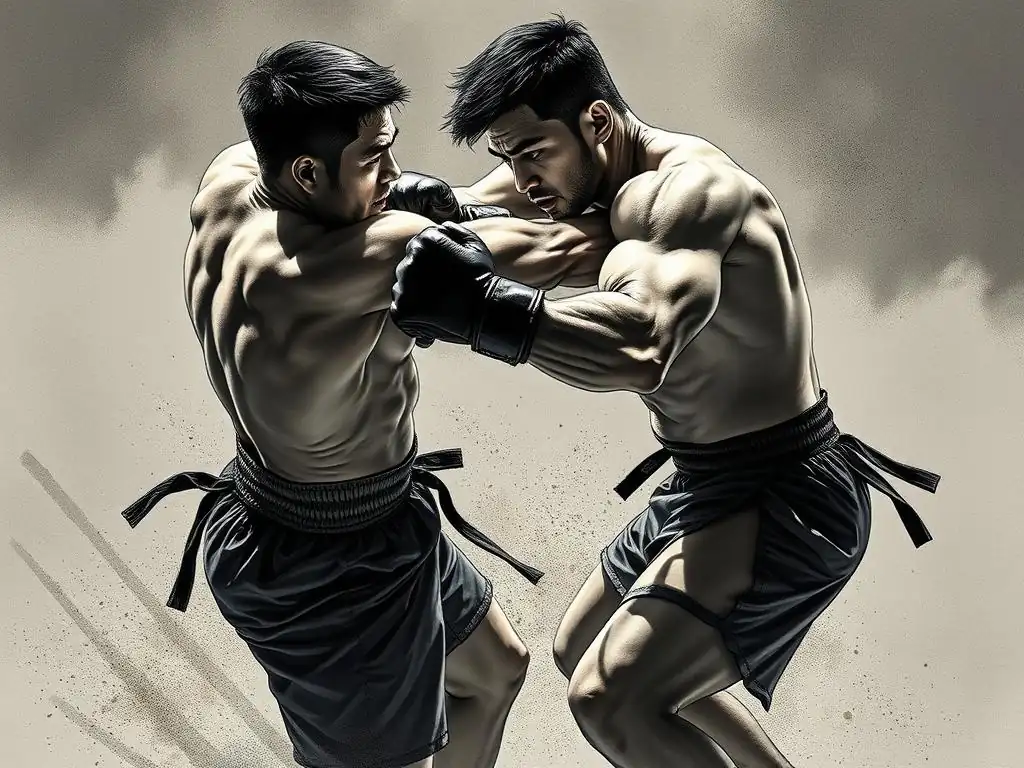
The fourth opponent is often characterized as an aggressive, forward-pressing warrior. This type of fighter relies on relentless pressure and perhaps brute force, aiming to overwhelm their opponent quickly. Facing such an attack requires composure and effective techniques to neutralize aggression without being drawn into a brawling match. The clinch is a cornerstone of Nai Khanom Tom Muay Thai for just such scenarios.
Against an aggressive warrior, Nai Khanom Tom would likely welcome the close-range exchange, turning the opponent's aggression against them. Entering the clinch, he could control the opponent's posture using neck ties and arm control. From this dominant position, he could unleash a barrage of short, powerful knee strikes to the thighs, ribs, and solar plexus. Effective sweeps and throws from the clinch could also disrupt the warrior's base and rhythm, demonstrating superior control and technique to secure the fourth victory.
Victory 5: The Strongman - Dominating with Elbow Strikes
The fifth fighter is often depicted as a strongman, relying on physical power and perhaps less on refined technique. Overcoming sheer strength requires precise application of force and targeting vulnerable points. Elbow strikes, one of the most devastating weapons in the Muay Thai arsenal, are particularly effective at close range against a larger, stronger opponent where leverage is key.
Facing a strongman, Nai Khanom Tom would avoid a direct test of strength. Instead, he would use movement to create angles and close distance quickly to get inside the strongman's reach. Once in range, sharp, cutting elbow strikes to the brow, temple, or bridge of the nose could cause immediate damage and disorientation, bypassing the strongman's muscular defense. Rising or downward elbow strikes in the clinch could also target the jaw or collarbone. These precise, high-impact strikes, characteristic of Nai Khanom Tom Muay Thai, would allow skill to overcome brute force for the fifth win.
Victory 6: The Agile Fighter - Mastering Muay Thai Kicks
The sixth opponent is often described as an agile fighter, possibly quick on their feet and difficult to pin down. This type of opponent requires tactics that can reach across distance and limit their mobility. Muay Thai kicks, known for their power and versatility, are ideal for controlling distance and inflicting damage on a mobile target.
Against an agile fighter, Nai Khanom Tom would use a variety of kicks to cut off escape routes and score points. Powerful roundhouse kicks to the legs (low kicks) would be essential to slow the opponent down and compromise their agility. Body kicks could target the ribs and arms, wearing them down. Teep kicks (front kicks) would maintain distance and interrupt the agile fighter's attacks. By effectively using the reach and power of his kicks, a hallmark of Nai Khanom Tom Muay Thai, he would dominate the space and secure the sixth victory.
Victory 7: The Defensive Expert - A Showcase of the Muay Thai Guard
The seventh challenger was reportedly a defensive expert, skilled at blocking and evading attacks, making them difficult to hit cleanly. Breaking through a strong defense requires patience, feints, and attacks from unexpected angles, as well as solid offensive techniques that can penetrate or bypass guards. Nai Khanom Tom's mastery of the Muay Thai guard, both offensive and defensive, would be crucial here.
Against a defensive expert, Nai Khanom Tom wouldn't just attack; he would use feints and combinations to create openings. He might attack high to draw the guard up, then follow with a low kick, or vice-versa. Using the Muay Thai guard offensively, such as using forearm blocks to parry and immediately counter, or using the shell guard to absorb blows and fire back, would be key. The power of his strikes, particularly elbows and knees delivered quickly after the opponent's failed attack, would be necessary to penetrate the defense and achieve the seventh victory.
Victory 8: The Powerful Striker - Precision and Power in Every Strike
The eighth opponent was likely a powerful striker, known for inflicting significant damage with their blows. Facing such an opponent requires careful defense, intelligent movement, and the ability to absorb or evade powerful attacks while delivering precise, impactful counters. Nai Khanom Tom's training emphasized generating maximum power and precision in every strike.
Against a powerful striker, Nai Khanom Tom would prioritize defensive movement and timing. Slipping punches, checking kicks, and using footwork to stay out of the direct line of fire would be essential. When countering, he would need to make every strike count, focusing power and precision. A well-timed cross or hook after slipping a punch, or a powerful knee to the body when the striker advanced, could capitalize on momentary vulnerabilities. His ability to deliver debilitating strikes, characteristic of Nai Khanom Tom Muay Thai, would allow him to overcome the powerful challenger for the eighth win.
Victory 9: The Strategist - A Masterful Approach to Combat
The ninth opponent is often described as a strategist, a fighter who relies on outthinking their opponent rather than just physical prowess. This would be a mental battle as much as a physical one, requiring Nai Khanom Tom to anticipate tactics and adapt his own approach. His deep understanding of Nai Khanom Tom Muay Thai principles would be put to the test.
Facing a strategist, Nai Khanom Tom would need to remain unpredictable while maintaining his core effectiveness. He might change tempos, switch stances, or use less common techniques to keep the opponent guessing. Reading the opponent's body language and movements to anticipate their next move would be crucial. Counter-strategy could involve drawing the opponent into traps or exploiting patterns in their attacks or defense. His comprehensive mastery allowed him to adjust his plan on the fly, outmaneuvering the strategist for the ninth victory.
Victory 10: The Grand Finale - The Final Triumph of Nai Khanom Tom
The tenth and final opponent was presumably the greatest champion Burma had to offer, representing the ultimate test. After nine consecutive, grueling fights, Nai Khanom Tom would have been exhausted, injured, but his spirit unbroken. This final bout was the culmination of his ordeal and the ultimate demonstration of the superiority of Siamese boxing.
In this grand finale, fueled by sheer will and the spirit of Nai Khanom Tom Muay Thai, he faced his toughest challenge. Every technique – the powerful kicks, sharp elbows, debilitating knees, and controlling clinch – would be employed with maximum effort despite his fatigue. The legend recounts a spectacular final performance where, through sheer determination and skill, he defeated the final champion. This tenth victory secured his freedom and cemented his legendary status, leaving the Burmese king and audience astonished by his incredible resilience and the devastating effectiveness of his fighting art.
Nai Khanom Tom's Fighting Style and Techniques
Signature Muay Thai Moves: Analyzing His Combat Prowess
While specific records detailing every technique used by Nai Khanom Tom in his legendary bouts are not available, we can infer his style based on the characteristics of Muay Thai during the Ayutthaya period and the descriptions of his victories. His ability to defeat ten different opponents with varying styles suggests mastery of the full range of Nai Khanom Tom Muay Thai weapons, including powerful punches, sharp elbows, devastating knee strikes, and versatile kicks.
His victories against fighters described as strongmen or aggressive warriors highlight his likely proficiency in close-range techniques, particularly the clinch and knee/elbow strikes. Defeating agile or defensive opponents points to effective use of kicks for distance control and breaking through guards, as well as strategic striking combinations. His overall success underscores the importance of adaptability, physical conditioning, and mental toughness – core tenets of traditional Muay Thai training.
The Importance of Wai Kru Ram Muay in Nai Khanom Tom's Era
The Wai Kru Ram Muay was not just a performative dance in Nai Khanom Tom's time; it was an integral part of the martial art itself, imbued with deep cultural and spiritual significance. The "Wai Kru" means paying respect to the teacher, and the "Ram Muay" is the boxing dance. This ritual served multiple purposes before a fight: paying homage to trainers, ancestors, and the spirits; physically warming up the body and loosening the muscles; mentally preparing the fighter for combat; and showcasing the fighter's style and skill to the audience and opponent.
For Nai Khanom Tom, performing the Wai Kru Ram Muay before his legendary fights in Burma would have been particularly poignant. It was an act of defiance and cultural assertion, a visible link to his homeland and traditions in a foreign land under duress. It demonstrated his respect for the art of Nai Khanom Tom Muay Thai and his lineage, possibly intimidating his opponents who were unfamiliar with the ritual. This tradition remains a vital part of Muay Thai today, connecting modern fighters to the historical and spiritual roots exemplified by Nai Khanom Tom.
The Cultural Impact of Nai Khanom Tom
Nai Khanom Tom Day: Celebrating a Muay Thai Icon
Nai Khanom Tom's legacy is officially celebrated every year on March 17th, known as Nai Khanom Tom Day or National Muay Thai Day in Thailand. This date commemorates his legendary victories in 1774 and honors his contribution to the recognition and preservation of Muay Thai. The day is marked by various events, including exhibitions, demonstrations, and Wai Kru ceremonies held across Thailand, particularly at the memorial statue of Nai Khanom Tom in Ayutthaya.
The celebration serves as a powerful reminder of Thailand's rich martial heritage and the enduring spirit of its people. It reinforces the status of Nai Khanom Tom Muay Thai as a national treasure and a symbol of resilience. For practitioners and fans globally, Nai Khanom Tom Day is an opportunity to reflect on the history of the art and the values it represents, connecting the modern sport to its ancient roots and the hero who fought for its honor.
Nai Khanom Tom's Influence on Modern Muay Thai Training
The story of Nai Khanom Tom continues to influence modern Muay Thai training in profound ways. His legendary endurance in fighting multiple opponents back-to-back emphasizes the importance of superior conditioning and stamina, which are central pillars of contemporary Muay Thai regimens. His ability to adapt to different opponents highlights the need for a versatile skill set, encouraging practitioners to master all the weapons of Muay Thai – punches, kicks, knees, and elbows – rather than specializing in just one or two.
Furthermore, his story reinforces the mental aspect of fighting: courage, determination, and the will to overcome adversity. Trainers often use the tale of Nai Khanom Tom Muay Thai to inspire students to push past their limits, emphasizing that mental strength is as crucial as physical prowess. The continued practice of the Wai Kru Ram Muay before fights is perhaps the most visible link, maintaining the connection to the history and respect for the art that Nai Khanom Tom embodied.
Nai Khanom Tom: Father of Muay Thai - A Lasting Inspiration
Lessons from the Legend: Applying Nai Khanom Tom's Principles to Martial Arts Today
The story of Nai Khanom Tom offers invaluable lessons applicable not only to Muay Thai but to all martial arts disciplines and indeed, to life itself. His legend teaches us:
- Resilience: Despite being a prisoner, he faced immense pressure and physical challenge, demonstrating incredible mental and physical fortitude.
- Adaptability: He successfully fought opponents with varied styles, showcasing the importance of being able to adjust techniques and strategy.
- Mastery: His victories were a result of deep mastery of his art, emphasizing that true effectiveness comes from dedicated practice and understanding of fundamentals.
- Respect: The Wai Kru Ram Muay highlights the importance of respecting one's teachers, lineage, and the art itself.
- Courage: Facing ten opponents consecutively requires immense bravery and an unyielding spirit.
Applying these principles means approaching training with discipline, respecting opponents and instructors, constantly seeking to improve skills, and cultivating mental toughness to overcome obstacles, embodying the spirit of Nai Khanom Tom Muay Thai.
Remembering Nai Khanom Tom: A Symbol of Courage and Skill for Future Generations
Nai Khanom Tom is more than a historical figure; he is a potent symbol. He represents the courage to stand up for oneself and one's heritage, even in the direst circumstances. He symbolizes the power of skill and dedication, proving that mastery of a craft can lead to extraordinary achievements. His story serves as a guiding light for aspiring martial artists, illustrating that the true power of a fighter lies not just in physical strength, but in technique, strategy, spirit, and cultural connection.
As the "Father of Muay Thai," his memory is preserved in gyms, in rituals, and in the hearts of practitioners worldwide. He reminds future generations that martial arts are not just about fighting; they are about developing character, honoring tradition, and embodying an unyielding spirit. The legend of Nai Khanom Tom Muay Thai ensures that the values he represented continue to inspire and guide the art for centuries to come.
Conclusion: The Unyielding Spirit of Nai Khanom Tom
Frequently Asked Questions
What is Nai Khanom Tom best known for?
Nai Khanom Tom is best known as the Father of Muay Thai. He achieved legendary status for his solo victory over ten Burmese warriors.
Why is Nai Khanom Tom considered a significant figure in Muay Thai history?
He embodies the spirit and resilience of Muay Thai. His story is a powerful symbol of Thai national pride and martial prowess.
Where can I find more information about Nai Khanom Tom's life and battles?
Resources on Thai history and Muay Thai are available. Websites like MartialArtsMastery.org offer detailed accounts and historical contexts.
What kind of Muay Thai techniques might Nai Khanom Tom have used?
While specifics are lost to time, he would have likely used fundamental Muay Thai striking and clinching techniques. These would include kicks, punches, knees, and elbows, adapted for self-defense and combat.
How does the story of Nai Khanom Tom inspire modern Muay Thai practitioners?
His story emphasizes courage, skill, and unwavering determination. It teaches practitioners the importance of mental fortitude alongside physical training.
Final Reflection: The Enduring Legacy of Courage and Skill
The story of Nai Khanom Tom, the Father of Muay Thai, is more than just a historical anecdote; it's a living testament to the unyielding spirit of human resilience and the power of cultural heritage. Even today, his legendary ten victories continue to inspire Muay Thai practitioners and enthusiasts worldwide, reminding us that true strength lies not only in physical prowess but also in unwavering determination and respect for tradition.
The impact of Nai Khanom Tom extends far beyond the ring. His story has become deeply interwoven with the cultural fabric of Thailand, serving as a powerful symbol of national pride and martial arts excellence. His legacy reminds us that even in the face of overwhelming odds, the human spirit can triumph. Victory belongs to the most persevering.
This quote, though not directly attributed to Nai Khanom Tom, perfectly encapsulates the essence of his unwavering commitment and the enduring impact of his legendary feats.
As we reflect on the life and accomplishments of Nai Khanom Tom, let us not only celebrate his victories but also embrace the values he embodied: courage, discipline, and respect. Let his story serve as a constant reminder that with unwavering dedication and a deep connection to our roots, we too can overcome challenges and leave a lasting legacy of our own. Embrace the spirit of Nai Khanom Tom in your own life, and strive to embody the same strength, resilience, and respect that made him a true legend.
Unleash Your Inner Warrior: Start Your Muay Thai Journey Today!
Thank you for diving into the legendary story of Nai Khanom Tom. We hope you've been inspired by his unwavering spirit and incredible skill. Now, it's time to channel that inspiration into action!
Here are a few ways you can connect with the world of Muay Thai and honor the legacy of its father:
- Take your first step: Sign up for a beginner's Muay Thai class at a local gym. Embrace the challenge and experience the art firsthand.
- Explore the rich history of Muay Thai by researching its cultural roots, traditional ceremonies, and legendary figures beyond Nai Khanom Tom.
- Share this incredible story with friends and family to spread the knowledge and appreciation for this amazing martial art.
What aspect of Nai Khanom Tom's story resonates most with you, and how will you incorporate his spirit of perseverance into your own life?