Nage no Kata Yoko Sutemi Waza: Uki Waza The Floating Technique Breakdown
🥋 Discover the art of Uki Waza Kata Breakdown in Nage no Kata Yoko Sutemi Waza, as we explore the floating technique’s…
Read article
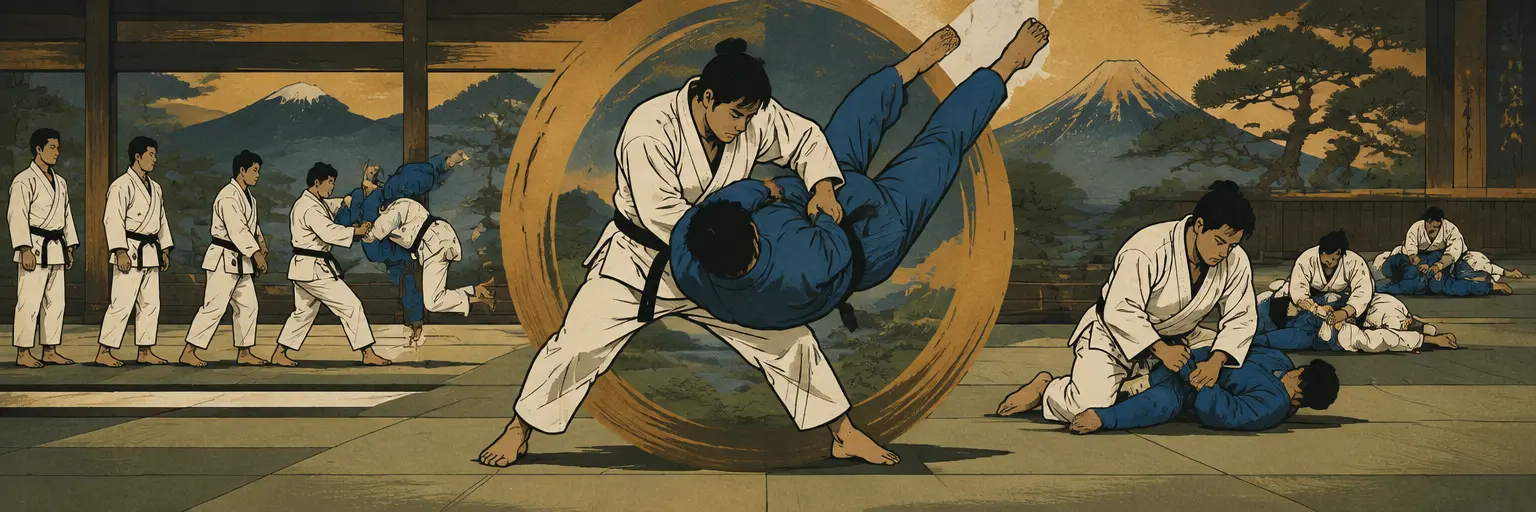
Discover the profound artistry behind Judo’s classical forms with our in-depth exploration of Nage no Kata and Katame no Kata—two essential pillars of technical precision and philosophical depth. 🌟 These kata are not mere choreography; they are living textbooks that encode the execution, timing, and hidden meaning behind Judo’s most powerful throws and grappling controls. By breaking down each movement’s purpose, from the seamless flow of *te-waza* (hand techniques) to the strategic immobilizations of *osae-komi-waza*, we reveal how these forms sharpen your combat instincts, improve *kuzushi* (balance-breaking), and cultivate *zanshin* (alert awareness). Whether you’re a beginner seeking structure or an advanced practitioner aiming to refine your *randori*, mastering these kata unlocks a deeper connection to Judo’s founder, Jigoro Kano, and the art’s core principle of *seiryoku zen’yo*—maximum efficiency with minimum effort. 🥋 Uncover the symbolism behind each sequence, the muscular coordination required for flawless transitions, and the tactical lessons that elevate your sparring.
🥋 Discover the art of Uki Waza Kata Breakdown in Nage no Kata Yoko Sutemi Waza, as we explore the floating technique’s…
Read article
🥋 Discover the art and science behind Nage no Kata Te Waza, focusing on Ippon Seoinage technique details, to master its form,…
Read article
🥋 Discover the mastery behind Nage no Kata Koshi Waza as we delve into the Harai Goshi technique details—exploring precise form, perfect…
Read article
🤼♂️ Mastering ukemi technique safety practice in Nage no Kata is vital for effective martial arts training, ensuring Uke’s protection, building confidence,…
Read article
🥋 Discover how Katame no Kata serves as Judo's foundational blueprint, enhancing mastery of ground control. Dive into our Judo groundwork techniques…
Read article
🤔 Discover the profound significance of Nage no Kata technique meaning, exploring how this classical judo form transcends mere mechanics to embody…
Read article
🌟 Explore the fascinating Judo Katame no Kata history, tracing its origins and evolution within Judo’s rich martial arts legacy, highlighting its…
Read articleJudo kata are not mere choreographed drills; they are the living archive of Judo’s technical and philosophical DNA. This subcategory focuses on the Nage no Kata (forms of throwing) and Katame no Kata (forms of grappling), breaking down their precise execution, historical lineage, and the deeper combat meaning behind each movement. For practitioners from white belt to black belt, understanding these kata isn’t just about passing grading—it’s about unlocking efficiency, rhythm, and the subtle mechanics that make Judo work against resisting opponents. Here, we analyze every throw, hold, and transition as a tactical system, not just a ritual.
The Nage no Kata comprises five distinct sets—hand, hip, foot, self-sacrifice (front and side)—totaling 15 throws that cover the entire spectrum of off-balancing (kuzushi) and entry (tsukuri). Each technique is performed with deliberate speed and control on both sides, with the uke (receiver) attacking in a predetermined pattern to simulate realistic combat scenarios. The execution is slow in appearance but sharp in feel, teaching the tori (thrower) to generate power from the core, maintain upright posture, and blend with uke’s momentum without relying on brute strength.
Beyond physical mechanics, this kata encodes the strategic principle of ju yoku go o seisu—gentleness controlling strength. Each throw demonstrates a specific response to a common attack, from a lapel grab to a strike, showing how to unbalance an opponent before they can act. For competition-focused judoka, practicing Nage no Kata sharpens your understanding of timing and angle, directly improving your randori performance. This analysis breaks down each of the 15 throws, highlighting the critical weight shift, foot placement, and breathing that separates a lifeless demonstration from a living combat application.
Katame no Kata consists of 15 techniques across three groups: osae waza (pinning), shime waza (strangulation), and kansetsu waza (joint locks). Unlike the dynamic throws of Nage no Kata, this kata emphasizes the gradual, methodical control of a grounded opponent, teaching how to transition from a failed throw to a dominant ground position. The execution prioritizes pressure, leverage, and safety, with each technique performed in a clear sequence that exposes the anatomical weak points—like the neck, elbow, and shoulder—where submission is inevitable.
Meaning-wise, Katame no Kata is a practical manual for self-defense and newaza (ground fighting). It teaches you to remain calm under resistance, to use your weight and hip alignment to crush an opponent’s escape attempts, and to apply submissions with precision rather than power. The kata also introduces the concept of kaeshi waza (reversals) implicitly, as you learn how each pin sets up a choke or lock. By dissecting the execution of these forms, you gain a blueprint for controlling larger, stronger opponents, making this subsection essential for both beginners and advanced judoka seeking to solidify their ground game.
Every movement in both Nage and Katame no Kata carries layers of symbolic meaning rooted in Japanese martial culture. For example, the opening bow (rei) is not a mere courtesy but a method of centering your focus and acknowledging your partner’s role in your development. The forward and backward steps (sabaki) mimic natural walking patterns, teaching you to move fluidly in any direction without crossing your feet—a critical skill for tournament survival. Even the rhythm—slow-fast-slow—mirrors the ebb and flow of real combat, where you must seize fleeting moments of imbalance.
This subcategory explores how the kata’s structured patterns serve as a meditative practice, improving mental clarity and reaction time under stress. For the martial artist, executing these forms correctly is not about memorizing sequences but about internalizing the principles of ma-ai (distance) and zanshin (awareness). We also connect each technique to its origin story—many throws are named after legendary samurai—providing a narrative context that enriches your practice. By studying the meaning, you move from mimicry to true understanding, able to adapt these core movements spontaneously in self-defense situations.
In this section, we provide a granular, movement-by-movement guide for every throw and hold, using annotated descriptions that highlight the precise angle of each hand grip, the exact placement of each foot, and the essential hikite (pulling hand) and tsurite (lifting hand) actions. You will find clear cues for common errors—such as bending the knees instead of using your hips, or breaking your own posture during a pin—and corrective drills to fix them. Each breakdown includes timing charts showing when to inhale and exhale, which is crucial for maintaining power without fatigue.
We also draw comparisons between the traditional kata versions and modern competition-adapted movements, explaining why the kata’s slower, deliberate pacing is superior for learning balance and control. The execution details are supported by clearance on the seiryoku zen’yo (maximum efficiency) principle—how to achieve the greatest effect with the least effort. Whether you are preparing for your next grading or refining your competitive edge, these step-by-step analyses transform complex sequences into manageable, teachable components. Practicing with this level of detail ensures your kata is not only beautiful but functional.
Practicing Judo kata without proper supervision can lead to injury—especially in Katame no Kata, where joint locks and chokes are performed at low speed but still risk hyperextension if applied incorrectly. This subcategory dedicates space to safety protocols: how to signal a submission, how to adjust pressure for a partner of different size, and when to stop a sequence to prevent strain. Common mistakes include telegraphing your intentions through shoulder tension, forgetting to keep your back straight, and rushing through the standing phases to reach the ground work.
We also outline a progression path from learning each individual technique to linking them into a fluid kata, followed by integrating a partner’s unpredictable responses. This helps you move from kata as performance to kata as living combat simulation. For instructors, we provide cues on how to teach these forms to beginners versus advanced students, emphasizing the shift from memorization to spontaneous application. The ultimate goal is competency under pressure—by drilling with dedicated intention, you build muscle memory that transfers directly into randori and real-world self-defense. Here, you’ll find a roadmap to make each practice session productive and injury-free.
Nage no Kata focuses exclusively on standing throwing techniques—15 throws across five sets—while Katame no Kata covers grappling on the ground: 5 pins, 5 chokes, and 5 joint locks. They complement each other, with Nage teaching how to bring an opponent down and Katame teaching how to control and submit them once on the ground.
In most Judo federations, both Nage no Kata and Katame no Kata are required for 1st dan (shodan) promotion. However, requirements vary by country and organization. Always confirm with your local governing body, but learning both is strongly recommended because they develop complementary skills essential for advanced Judo.
With consistent practice—two to three sessions per week—most dedicated judoka learn the entire sequence in 6 to 12 months. However, achieving true proficiency, where each movement is crisp and purposeful, may take several more years of refinement. It’s not about speed but about internalizing correct mechanics.
Absolutely. The fundamental pins and submissions in Katame no Kata—like kesa-gatame and juji-gatame—are identical to BJJ techniques. Practicing the kata teaches you proper weight distribution and pressure, improving your BJJ guard passing and submission setups. It’s an excellent cross-training tool for any ground grappler.
You can practice the footwork, hand positions, and timing solo using a mirror or video demonstration. However, full execution requires a partner to act as uke and offer realistic resistance. Solo repetition of steps is great for memorization, but partner work is essential for understanding body dynamics and achieving correct rhythm.