Robson Gracie: The Political Force Within the Gracie Family
🥋 Discover Robson Gracie's profound political influence within the legendary Gracie family. This profile explores his strategic impact and legacy on martial…
Read article
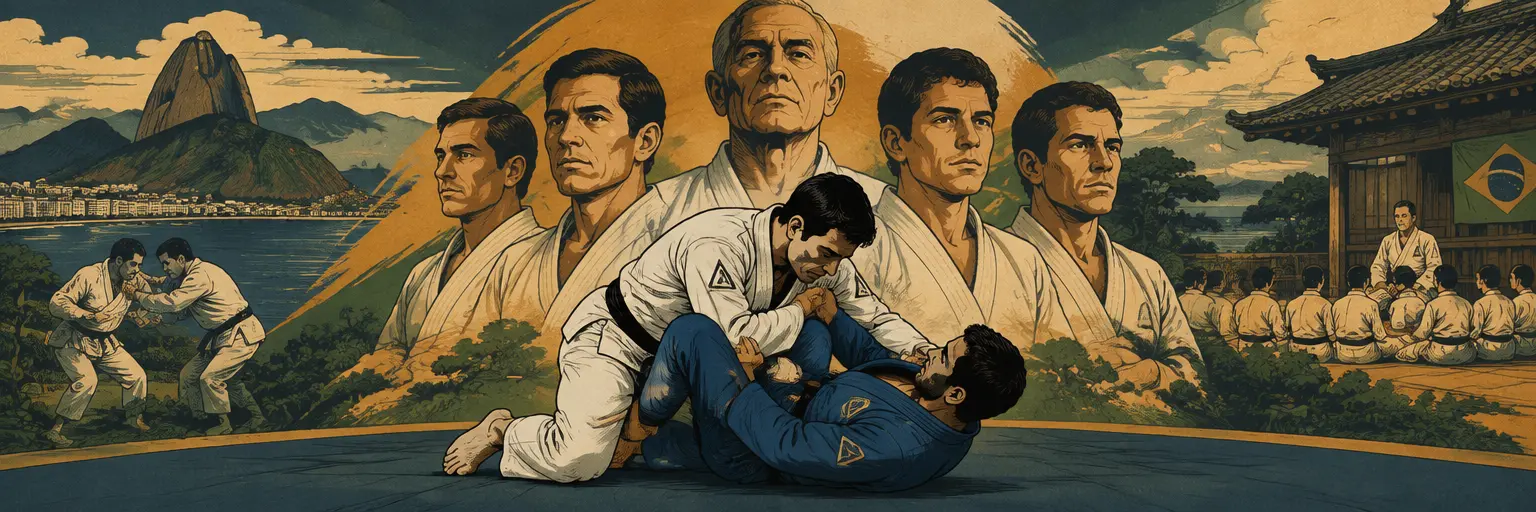
Brazilian Jiu-Jitsu (BJJ) is far more than a combat system—it’s a living legacy of strategy, adaptation, and family honor. Born from the genius of the Gracie family, this ground-fighting art revolutionized martial arts by proving that technique and leverage can overcome brute strength, empowering smaller practitioners to dominate larger opponents. The journey begins with Mitsuyo Maeda, a Japanese judoka who brought Judo to Brazil, where he taught Carlos Gracie in the early 1900s. From there, Carlos and his brother Hélio refined the techniques, focusing on positional control, submissions, and survival, creating a system where every roll on the mat becomes a chess match of timing, pressure, and patience. This isn’t just about sport—it’s about real-world self-defense, as the Gracies famously challenged and defeated practitioners of other styles in the early Vale Tudo contests. Understanding BJJ’s origins reveals how a family’s obsession with efficiency turned a niche skill into a global phenomenon, influencing MMA, personal fitness, and a culture of respect, resilience, and lifelong learning.

🥋 Discover Robson Gracie's profound political influence within the legendary Gracie family. This profile explores his strategic impact and legacy on martial…
Read article
🥋 Discover how the Carlos Gracie nutrition diet plan reflects a holistic approach to health and martial arts mastery. This dietary philosophy,…
Read article
🥋 Discover how the Gracie family’s timeless Gracie BJJ competition strategies continue to influence modern BJJ tournaments, blending traditional techniques with innovative…
Read article
🥋 Discover the extraordinary Helio Gracie red belt journey, a testament to dedication and innovation. This article on MartialArtsMastery.org delves into the…
Read article
🌟 Explore the lesser-known yet impactful contributions of the Gracie siblings in shaping the Gracie siblings martial arts legacy, highlighting how their…
Read article
🥋 The Gracie family martial arts training legacy continues as the first generation meticulously passed down techniques and philosophies to the next,…
Read article
🥋 Helio Gracie's revolutionary BJJ techniques transformed self-defense, emphasizing leverage and technique over strength. His innovations continue to shape modern BJJ, making…
Read articleBrazilian Jiu-Jitsu (BJJ) is more than a martial art—it is a revolutionary combat system that empowers smaller practitioners to overcome larger opponents through leverage, technique, and strategic positioning. At its heart lies the legendary Gracie family, whose relentless innovation transformed traditional Japanese Judo and Jiu-Jitsu into a ground-fighting masterpiece. This subcategory dives deep into the historical roots, cultural evolution, and pivotal figures that shaped BJJ, offering a comprehensive resource for enthusiasts, historians, and aspiring grapplers alike.
BJJ’s story begins in early 20th-century Japan, where Kodokan Judo founder Jigoro Kano refined classical Jiu-Jitsu into a sport-competitive system. In 1914, Japanese judoka Mitsuyo Maeda traveled to Brazil as part of a global demonstration tour. Maeda, known as "Count Combat," shared his profound knowledge with the Gracie family, particularly Carlos Gracie, who became the first Brazilian to master these techniques. Maeda’s teachings emphasized real-world effectiveness over sporting rules, planting the seeds for a martial art focused on ground control and submissions.
The pivotal shift occurred in the 1920s when Carlos Gracie began teaching his younger brothers, including Helio Gracie. Helio, physically frail, adapted the techniques to rely on timing, angles, and leverage rather than strength, creating a "gentle art" accessible to all body types. This adaptation marked a departure from Judo’s standing throws, prioritizing groundwork and a positional hierarchy—side control, mount, and back control—that became BJJ’s core. The Gracie family’s relentless testing in unsanctioned "vale tudo" fights proved these methods against wrestlers, boxers, and strikers, solidifying BJJ as a superior self-defense system.
Helio Gracie (1913–2009) is universally revered as BJJ’s technical father. Suffering from a weak heart and chronic fatigue, Helio could not execute Judo’s brute-force maneuvers, so he slowed the learning process and re-engineered movements to require minimal physical strength. His ingenious innovations—such as the closed guard, the triangle choke, and the elbow escape—prioritized hip movement and weight distribution over muscular power. Helio’s philosophy, "If you are stronger, you can do anything; if you are weaker, you must do everything right," became BJJ’s foundational creed.
His competitive legacy includes the fabled 1951 bout against Masahiko Kimura, a legend of Japanese Judo. Helio, outweighed by 30 pounds, survived for 13 minutes before being caught in a reverse arm lock now named the "Kimura." Though he lost, Helio’s display of resilience and technique stunned the martial arts world, proving BJJ practitioners could hold their own against heavier specialists. Beyond competition, Helio helped formalize BJJ’s belt ranking system and co-founded the Gracie Academy in Rio de Janeiro, cementing an educational dynasty that continues to produce world champions.
The Gracie family’s internal competition and bold challenges shaped BJJ’s global expansion. Sibling rivalries—especially between Royce and Rickson Gracie—pushed technical innovation and mental toughness. However, the art’s mainstream breakthrough arrived in 1993 with the first Ultimate Fighting Championship (UFC), where Royce Gracie, a relatively small fighter, defeated larger opponents from boxing, karate, and wrestling using pure BJJ. Royce’s victories in four of the first five UFC events demonstrated BJJ’s superiority in no-rules combat, ushering in the modern mixed martial arts (MMA) era.
The Gracie family’s marketing genius—the "Gracie Challenge" in which they invited any martial artist to face them—created legendary fights that became viral before the internet. These challenges, often held at their academy, showcased BJJ’s effectiveness against all styles, from kung fu to sambo. Meanwhile, family disputes, such as the split between Carlos’s and Helio’s lineages, led to distinct sub-schools like Gracie Barra and Gracie Humaitá, each preserving different aspects of the art. The family’s collective influence remains unmatched, with Gracies continuing to compete, teach, and innovate across the globe.
The origins of BJJ established a technical framework still practiced today. Core positions include the guard (where a bottom fighter controls an opponent using their legs), side control (a dominant cross-chest pin), mount (straddling the opponent’s torso), and back control (hooking legs around the waist). Fundamental submissions from the Gracie era include rear-naked choke, armbar, and triangle choke—each designed to exploit anatomical weaknesses. Positional dominance, not points, was the original goal, with a practitioner advancing to a finish or a critical advantage.
Training methodology from the Gracie Academy emphasized live sparring ("rolling") rather than solo drills, allowing real-time experimentation against resisting partners. The family also promoted "Gracie Jiu-Jitsu" as a self-defense system, integrating strikes and takedowns that differ from sport-focused BJJ. Concepts like leverage, timing, and control of distance were drilled relentlessly, forming a unique problem-solving mindset. Understanding these foundational techniques provides practitioners with a direct link to BJJ’s roots, enabling them to appreciate how modern sport BJJ evolved while retaining its core efficiency and tactical depth.
Today, BJJ is a global phenomenon with millions of practitioners across every continent. The Gracie family’s legacy persists through their global academies, while modern competitors like the Mendes brothers and Buchecha have added athleticism and modern guard innovations. However, the roots remain visible: every white belt learns the same guard escapes and hip tosses that Helio codified. The art’s philosophical emphasis on humility, constant learning, and resilience attracts diverse participants—from hobbyists to professional athletes.
Contemporary BJJ has fragmented into sub-disciplines such as no-gi grappling (lucha libre styles) and "self-defense Jiu-Jitsu," but all recognize the Gracie lineage. Organizations like the International Brazilian Jiu-Jitsu Federation (IBJJF) standardize rules derived from Gracie principles, while online platforms democratize instruction. For a serious student, understanding the origins isn’t just historical trivia—it unlocks the "why" behind positions and submissions, fostering more adaptive and intelligent grappling. The Gracie family’s story remains a testament to how one family’s stubborn innovation can change combat sports forever, making BJJ a living, evolving tradition.
Brazilian Jiu-Jitsu was founded by the Gracie family, notably Carlos and Helio Gracie, who adapted Japanese Judo and Jiu-Jitsu techniques brought to Brazil by Mitsuyo Maeda in 1914. Helio’s refinements focusing on leverage and technique for weaker practitioners solidified BJJ as a distinct martial art.
While both arts share origins, Judo emphasizes throwing and upright combat, with ground fighting limited to a few seconds. BJJ focuses almost exclusively on ground control, positional advancement, and submissions, allowing extended ground engagements and a deeper sub-technique hierarchy.
Royce Gracie’s victories in early UFC events (1993–1994) demonstrated that a smaller, technically proficient BJJ practitioner could defeat larger strikers and wrestlers, proving BJJ’s effectiveness in real combat. This shifted MMA toward grappling, helping launch the modern sport and mainstream BJJ’s popularity.
Yes. BJJ’s core philosophy from Helio Gracie is that technique and leverage overcome strength. Smaller practitioners learn to use angles, weight distribution, and submissions like chokes and joint locks to neutralize larger opponents safely. Starting with a qualified instructor is key.
The Gracie Challenge was an open invitation issued by the Gracie family during the 20th century, daring practitioners of any martial art to fight them under minimal rules. Through these unsanctioned bouts, they demonstrated BJJ’s supremacy over boxing, karate, and wrestling, helping build its reputation.







