Founders of Modern Martial Arts: Biographies and Legacies
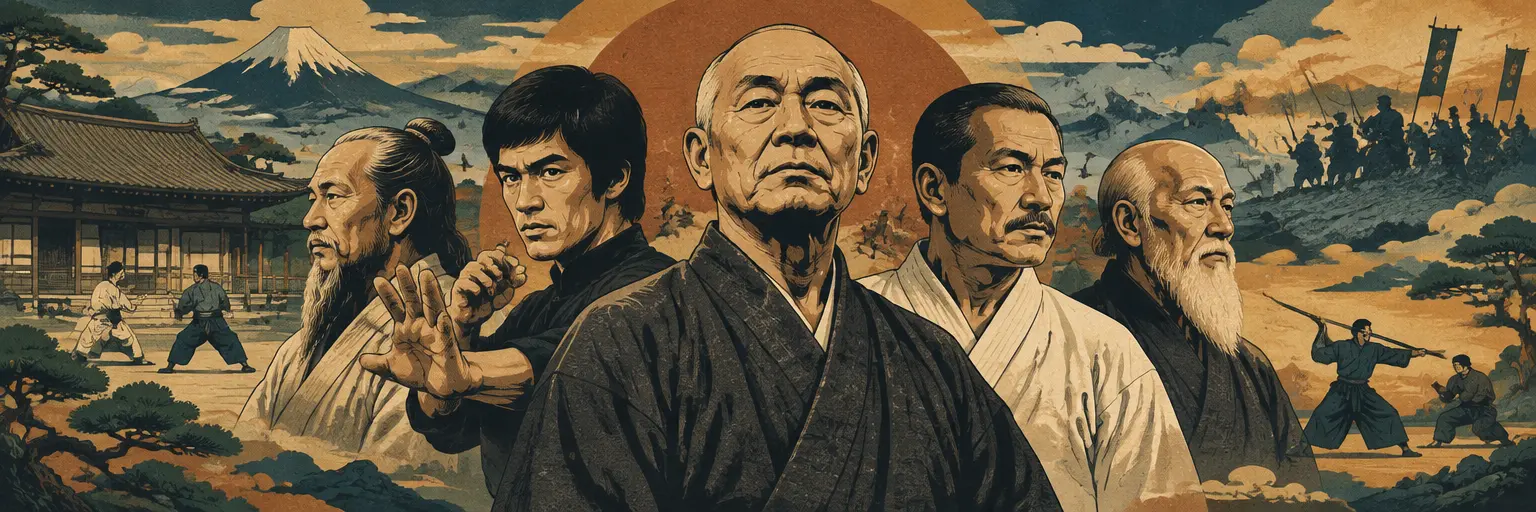
Dive into the lives of the visionaries who shaped combat into codified systems, transforming ancient techniques into the modern disciplines practiced worldwide. This subcategory on Martial Arts Mastery explores the personal journeys, cultural contexts, and enduring philosophies of the founders who defined karate, taekwondo, judo, Brazilian Jiu-Jitsu, and other martial arts. Understanding their biographies is key to grasping the technical evolution and spiritual core of each style. Here, we connect the legacy of each master to modern training methods, ensuring their stories continue to inspire your practice.
🥋 The Pioneers of Karate: From Okinawa to Global Dojos
Explore how figures like Gichin Funakoshi, Chojun Miyagi, and Kenwa Mabuni transformed indigenous Okinawan striking arts into the formalized systems of Shotokan, Goju-Ryu, and Shito-Ryu. Their biographies reveal a delicate balance between preserving tradition and adapting to modernization, including the critical integration of weapons disarming and kata practice. You will understand how these masters navigated political pressures and cultural shifts to bring karate to mainland Japan and, eventually, the world.
Each founder’s personal story is a lesson in resilience. Funakoshi, often called the "father of modern karate," emphasized character development over combat victory, embedding philosophical maxims like "karate ni sente nashi" (no first attack) into his teaching. By studying Miyagi’s emphasis on breathing and internal power or Mabuni’s synthesis of hard and soft techniques, you gain practical insights into why certain stances and strikes exist. This section helps you trace your own dojo lineage back to these pioneers, enriching every kata you perform with historical depth.
🥋 Jigoro Kano and the Birth of Judo: A Path of Maximum Efficiency
Discover how Jigoro Kano, a scholar and educator, founded Judo in 1882 by refining traditional jujutsu into a modern sport and martial art. Kano’s vision was revolutionary: he removed lethal techniques, prioritized safety for practice, and introduced the concept of randori (free practice) as a pedagogical tool. His biography is a masterclass in intellectual curiosity, as he systematically analyzed various jujutsu schools to select techniques that embodied his principle of seiryoku zen'yo (maximum efficiency, minimum effort).
Kano’s legacy extends far beyond the throwing techniques and grappling pins you practice today. He established the dan/kyu ranking system now used globally and founded the Kodokan institute, which remains the spiritual home of judo. By examining his biography, you understand how judo’s focus on mutual welfare and benefit ("jita kyoei") was designed to build moral character, not just athletic prowess. This historical insight helps modern practitioners appreciate the etiquette and competitive rules that make judo both a sport and a discipline for life.
🥋 The Evolution of Taekwondo: Founders of Korean Unified Striking
Meet the nine original kwans and their leaders—such as General Choi Hong Hi and Choi Yong Sul—who consolidated Korean martial arts after 1945. This section unravels the complex biographies behind taekwondo’s unification, highlighting how military influence and national identity shaped its high-kicking, dynamic style. Learn how General Choi codified the Chang Hon tul (patterns) and played a pivotal role in the art’s global proliferation, even amidst political controversy over its origins and governing bodies.
Understanding the founders' legacies clarifies the diversity within taekwondo, from the more linear ITF style to the sport-oriented WT Olympic format. The biographies reveal a fusion of indigenous taekkyeon, karate influences, and Chinese martial arts that created a unique, fast-paced system. As a practitioner, you’ll see why speed, agility, and timing are emphasized over raw power, and how the founder’s military discipline instilled a strong mental focus that remains central to modern taekwondo forms and sparring.
🥋 Helio Gracie and Carlos Gracie: The Legacy of Brazilian Jiu-Jitsu
Immerse yourself in the Gracie family saga, where Helio Gracie leveraged leverage to create Brazilian Jiu-Jitsu (BJJ). Helio, frail as a youth, adapted traditional judo and jujutsu techniques taught by Mitsuyo Maeda to rely on ground fighting, submissions, and positioning rather than strength. His biography is a testament to adaptability, proving that a smaller person could defeat a larger attacker through technical efficiency, a core pillar of BJJ’s philosophy.
The Gracie legacy is defined by the famous “Gracie Challenge” and the creation of the Ultimate Fighting Championship (UFC), which showcased BJJ’s effectiveness to the world. Carlos established the business model and family lineage, while Helio refined the guard and sweeps that are now standard. By studying their biographies, you understand why BJJ emphasizes live rolling and belt progression as a measure of practical skill over tradition. This legacy encourages modern students to embrace problem-solving on the mat, making every roll a conversation with history.
🥋 Bruce Lee: The Founder of Jeet Kune Do and Modern Hybridization
Explore how Bruce Lee’s biography redefined the concept of a martial arts founder. Rather than creating a rigid system, Lee founded Jeet Kune Do (JKD) as a philosophy of "using no way as way," encouraging practitioners to absorb what is useful and discard what is not. His legacy stands on breaking traditional boundaries, integrating boxing, fencing, wing chun, and wrestling into a fluid, direct style focused on practical self-defense and speed.
Lee’s impact goes beyond technique; he popularized cross-training and physical conditioning as essential components of martial arts mastery. His biographies often highlight his frustration with traditional forms, which led to his famous “be like water” principle. For modern enthusiasts, his legacy is a call to personalize your training, emphasizing efficiency, timing, and adaptability over stylistic purity. JKD’s influence is visible in MMA and many modern self-defense curriculums, proving that a founder’s vision can outlive his physical practice.
Frequently Asked Questions
Who is considered the founder of modern karate, and why?
Gichin Funakoshi is widely regarded as the father of modern karate. He systematized Okinawan striking techniques into Shotokan, introduced them to Japan in the 1920s, and emphasized character development, making karate a path for self-improvement and not just combat. His biography provides the philosophical framework for modern dojo etiquette.
How did Jigoro Kano’s judo differ from traditional jujutsu?
Kano removed many lethal and dangerous techniques from jujutsu, focusing on safety and mutual welfare. He introduced randori (free practice) to develop real-time skills and created a belt ranking system. His goal was physical education and moral growth, not just battlefield survival.
What is the main difference between ITF and WT taekwondo regarding their founders?
General Choi Hong Hi founded the ITF style, emphasizing patterns (tul) and a more traditional, combat-oriented approach. WT taekwondo, developed later under Kukkiwon, focuses on sport and Olympic sparring rules. Both share roots in the same founders but diverged in training goals and government support.
Why did Helio Gracie create Brazilian Jiu-Jitsu if he was not a traditional founder?
Helio’s biography shows he struggled with his health and lacked the strength for traditional judo. He modified Maeda’s techniques to use leverage and positioning, proving that technique could overcome physical disadvantage. This adaptation became BJJ, a unique system focused on ground fighting and submissions.
Is Jeet Kune Do considered a fixed martial art style today?
No, Jeet Kune Do is a philosophy and a set of principles, not a fixed system. According to Bruce Lee’slegacy, it encourages practitioners to absorb what is useful, discard what is not, and express themselves freely. Most modern JKD schools teach a combination of boxing, kicking, and trapping while promoting adaptability over rigid forms.