Western Pioneers and Promoters of Martial Arts: The Bridge Builders of Combat
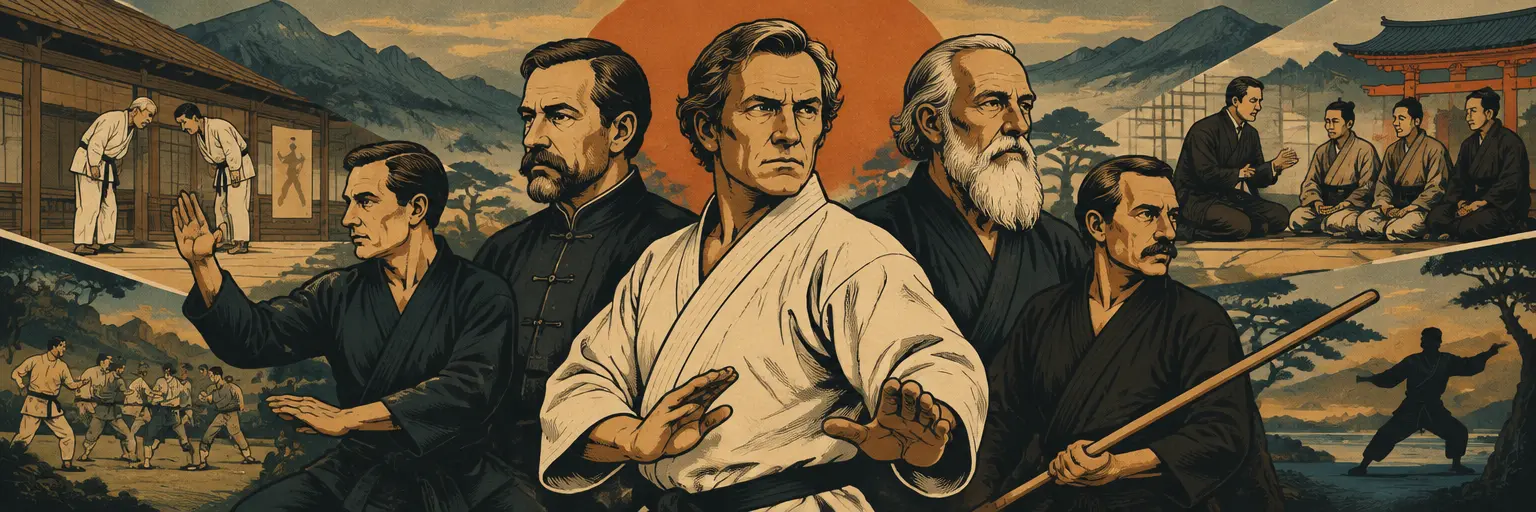
Before the global explosion of MMA and dojos on every corner, a handful of daring Westerners traveled to Asia, learned the ancient arts, and returned home to introduce them to the West. These pioneers were not just students; they were translators, innovators, and relentless promoters who transformed exotic fighting systems into accessible disciplines for millions. This subcategory celebrates their lives, sacrifices, and enduring legacies, showing how their courage shaped modern martial arts culture, from Bruce Lee’s philosophical blend to practical self-defense for civilians.
🥋 The First Wave: Post-War Martial Arts Ambassadors
Following World War II, American and British servicemen stationed in Japan, Korea, and Okinawa encountered martial arts in their rawest forms. Men like Robert Trias and Donn Draeger studied under native masters, often against strict cultural protocols, and brought back kata, sparring, and philosophy to Western gyms. These early ambassadors laid the groundwork for systematic teaching, establishing the first ranking systems and organizations outside Asia.
Their contribution was not merely technical but logistical—they created syllabi, printed manuals, and founded associations that standardized training. Without their initial translations of Japanese and Chinese terminology, the West would have struggled to grasp concepts like *ki*, *ma-ai*, and *hombu*. They faced skepticism from traditionalists yet persevered, proving that martial arts could thrive beyond their cultural origins, blending respect for tradition with Western organizational efficiency.
🕊️ The Visionary: Bruce Lee and Jeet Kune Do’s Global Reach
No Western promoter is more iconic than Bruce Lee, whose Hong Kong-American upbringing made him a cultural bridge. Rejecting rigid classical styles, he synthesized elements of Wing Chun, Western boxing, and fencing into Jeet Kune Do, emphasizing practicality and individual expression. Through films like *Enter the Dragon*, he captivated global audiences, making martial arts a cinematic and athletic aspiration for millions.
His influence extended beyond technique—Lee challenged the racial stereotypes of martial artists and promoted philosophical introspection, citing Taoism and Zen. He taught that martial arts were a path to self-knowledge, not just combat. Today, his legacy fuels millions of practitioners who carry his novels, *Tao of Jeet Kune Do*, and his rejection of “moon-pointing-at-finger” dogmatism, ensuring his role as the quintessential Western-born promoter of Eastern arts remains unmatched.
🏆 Institutional Builders: The Rise of Western Federations
From the 1960s onward, figures like Mike Stone and Jhoon Rhee (the “Father of American Taekwondo”) transformed martial arts into organized, credential-based sports. Rhee introduced the first colored belt system in the US and collaborated with Bruce Lee on demonstrations, while Stone, a karate champion, founded competitions that later became professional fighting circuits. Their work normalized belt exams, tournament sparring, and instructor certifications.
These institutional builders also pioneered mass marketing, using magazine ads, mail-order courses, and televised tournaments to attract students. They established governing bodies like the U.S. Karate Federation, which set safety standards and competitive rules. By formalizing grading and competition, they made martial arts accessible to families and children, turning a niche hobby into a mainstream lifestyle and creating the commercial infrastructure that supports modern gyms and academies.
🌍 Cultural Translators: Connecting East and West Philosophically
Beyond technique, Western pioneers like George Hamilton (co-founder of the first aikido dojos in the US) and Mary Parker (a female judo pioneer) worked to translate spiritual and ethical dimensions for Western audiences. They authored books explaining *bushidō*, the way of the warrior, adapting its codes of honor, loyalty, and discipline for modern ethical dilemmas. Their writing demystified meditation, breathing, and mindfulness as core training components.
These translators also addressed gender barriers, showing that martial arts were not exclusive to men—Parker’s judo school in the 1950s welcomed women, setting a precedent for inclusivity. They hosted cross-cultural seminars, inviting Japanese masters to the US and sending Westerners to study abroad, creating a two-way exchange. Their philosophical glossaries, such as explaining *mushin* (no-mind) through Western psychology, made concepts like non-attachment relatable, enriching both personal practice and academic study.
⚔️ Modern Practical Promoters: From Self-Defense to Sport
Contemporary promoters like Gracie family (although Brazilian, their adaptation of Judo into BJJ reached Western markets) and Joe Lewis, a pioneer of American kickboxing, focused on real-world applicability. Lewis combined karate’s linear strikes with Western boxing’s footwork, creating a fully contact sport that led to today’s kickboxing and MMA formats. Meanwhile, self-defense experts like Jeff Cooper promoted firearm and hand-to-hand combat integration for civilians.
These promoters embraced multimedia—YouTube instructionals, instructional DVDs, and live-streamed seminars—reaching millions at low cost. They emphasized street-ready drills, de-escalation, and situational awareness, moving beyond kata to scenario-based training. Their competitions, such as the early UFC events, broke barriers between styles, proving that a Westernized hybrid approach could outperform isolated traditionalists. In doing so, they made martial arts a mainstream fitness and survival tool, not an exotic art.
🤝 Legacy and Ongoing Influence in Today’s Dojo
The work of these pioneers persists in every modern martial arts class. Their standardized terminology, grading structures, and safety protocols are taken for granted, yet they stem from careful adaptation. Western instructors now teach millions of students using methods refined by these early promoters, who prioritized clarity, ethical teaching, and evidence-based progress.
Current trends, including cross-training in multiple arts (e.g., combining judo, muay thai, and wrestling), directly trace back to Lee’s and Lewis’s philosophies. Moreover, their inclusive attitudes—welcoming children, women, and older adults—have expanded the demographic base of martial arts, promoting lifelong health and community. Their stories inspire new generations to innovate, yet remember respect for tradition, ensuring the bridge they built continues to grow stronger, more diverse, and more accessible than ever.
Frequently Asked Questions
Who is considered the first Western martial arts pioneer?
Many cite Robert Trias, an American who studied Okinawan karate after WWII and founded the first U.S. karate school in 1946. He established the All-American Karate Federation, which standardized early ranking systems and competitions, making him a foundational figure in mainstreaming karate for Western practitioners.
How did Bruce Lee change the promotion of martial arts?
Bruce Lee broke cultural and stylistic barriers, blending multiple arts into Jeet Kune Do and publicly rejecting rigid tradition. His films and philosophy made martial arts accessible, emphasizing efficiency over form. He also challenged racial stereotypes, portraying martial arts as a universal science, not an exotic Eastern secret.
What role did federations play in Western martial arts growth?
Federations like the U.S. Karate Federation and U.S. Judo Association provided organizational frameworks—uniform belt systems, referee rules, and instructor certifications. They legitimized martial arts as regulated sports, allowing insurance, sponsorships, and school growth. This institutional backing attracted families and athletes, fueling the 1970s karate boom.
Are modern MMA promoters considered Western martial arts pioneers?
Yes, figures like Art Davie and Campbell McLaren (UFC creators) extended pioneering work by demonstrating cross-style effectiveness. They merged Western boxing, wrestling, and BJJ into a regulated sport, emphasizing safety and athleticism. Their promotion proved that mixed systems can evolve from traditional arts, honoring the original pioneers’ spirit of innovation.
What distinguishes a promoter from a practitioner in this context?
A promoter actively spreads the art—building organizations, writing instructional materials, organizing events, or using media to reach new audiences. While practitioners focus on personal mastery, promoters sacrifice personal fame for systematic growth, translating techniques, and fighting for acceptance. Most pioneers were both, but their promotional efforts—creating schools and documentation—are what secured their historical impact.