Explore the Dynamic Evolution of Taekwondo: From Ancient Roots to Global Sport
Welcome to Martial Arts Mastery’s deep dive into Taekwondo: History and Development (WT/ITF)—a journey through one of the world’s most practiced martial arts. Here, we unravel the fascinating transformation of Taekwondo from Korean martial traditions to a modern Olympic sport and a diverse self-defense system. You’ll discover the pivotal differences between the World Taekwondo (WT) and International Taekwon-Do Federation (ITF) styles, tracing their shared origins, political schisms, and technical evolution. Whether you’re a beginner seeking context, a seasoned practitioner, or a history enthusiast, this subcategory provides authoritative, SEO-rich insights into forms, sparring, philosophy, and global expansion. Prepare to deepen your understanding of how Taekwondo shaped—and was shaped by—history, culture, and sport.
🛡️ Ancient Korean Roots and Indigenous Martial Arts
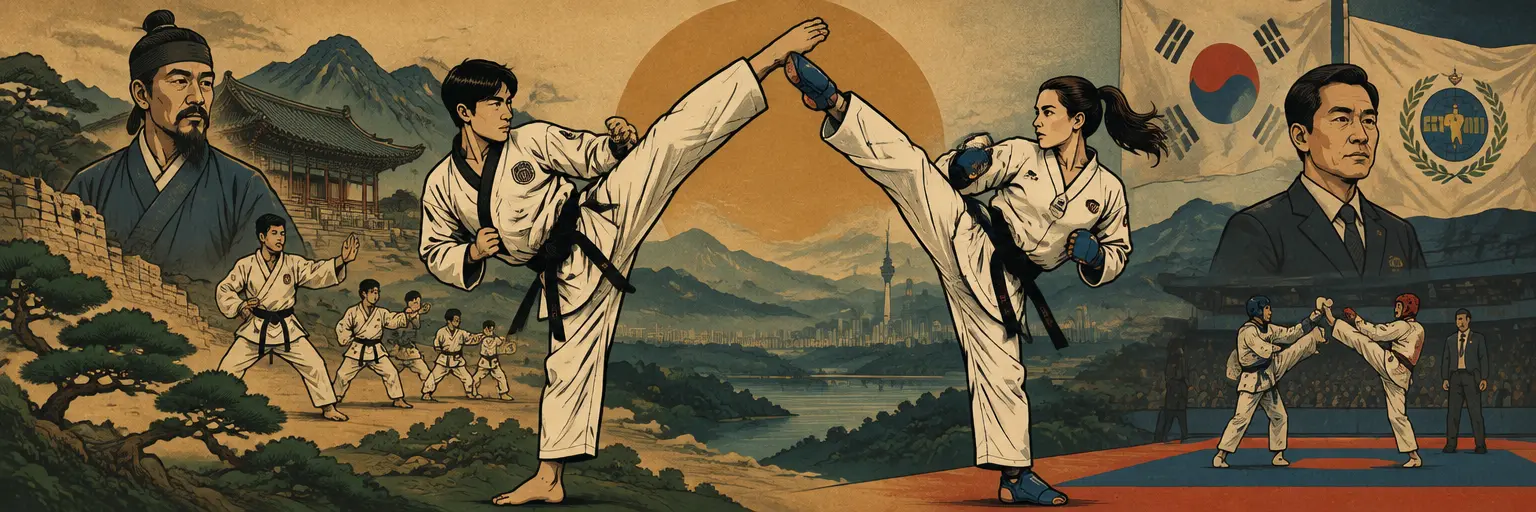
Taekwondo’s lineage extends back over 2,000 years to Korea’s Three Kingdoms period, where arts like Taekkyon and Subak flourished. These indigenous practices emphasized dynamic kicks, footwork, and joint locks, which later became foundational to modern Taekwondo. Historical records, such as the Muyejebo (military manuals) from the Joseon Dynasty, document systematic training methods and combat techniques that prioritized agility and leg strength—hallmarks still celebrated today. This era also saw the influence of Buddhist monastic traditions, which introduced philosophical discipline and meditation to martial practice, creating a holistic system that combined physical prowess with mental focus. By understanding these early roots, you’ll see that Taekwondo is not a 20th-century invention but a living heritage refined over centuries.
During the Japanese occupation (1910–1945), Korean martial arts were suppressed, forcing practitioners to train in secret or under the guise of Japanese karate. This period paradoxically blended Korean techniques with Okinawan karate’s linear strikes and stances, creating a hybrid that would later morph into Taekwondo’s distinctive style. After liberation in 1945, Korean masters sought to reclaim and synthesize their martial heritage, laying the groundwork for a unified national art. In this subcategory, we explore these formative decades, including the role of legendary pioneers like General Choi Hong-hi and the Kwans (five original schools) that competed and collaborated to define a singular Korean identity. Expect to gain a nuanced appreciation of how political turmoil, cultural pride, and external influences collectively forged Taekwondo’s early DNA.
🥋 The Birth of Formal Taekwondo and the Kwan Era (1945–1960s)
After 1945, five major schools—known as the Kwans—emerged across Korea, each teaching a distinct blend of karate, Taekkyon, and other influences. These schools (including Chung Do Kwan, Moo Duk Kwan, and Jidokwan) were instrumental in standardizing techniques and terminologies. In 1955, a naming committee, led by General Choi Hong-hi, officially adopted the name “Taekwondo” (meaning “way of the foot and fist”) to unify these fragmented systems under one banner. This era saw intense debates over whether to emphasize traditional forms (poomsae) or practical combat, eventually leading to the creation of the International Taekwon-Do Federation (ITF) in 1966 by Choi. His ITF style emphasized sine wave motion, powerful hip rotation, and a more self-defense-oriented, traditional approach, making it distinct from the later sport-focused variant.
Simultaneously, the Korea Taekwondo Association lobbied to make Taekwondo the national sport, pushing for government backing and military integration. By the early 1960s, Taekwondo was mandatory for South Korean military and police, leading to rapid dissemination among soldiers and civilians. This period also saw the first international demonstrations, as Korean instructors traveled to Southeast Asia, the Middle East, and the United States, sowing the seeds for global growth. In this section, we dissect the critical decisions—like the separation of organizational bodies—that shaped the technical and philosophical divergences still visible today. You’ll learn why pattern (tul) sequences, belt grading systems, and sparring rules differ so dramatically between WT and ITF, and how these differences reflect each organization’s mission, audience, and era of formation.
🌍 World Taekwondo (WT) vs. ITF: Divergent Paths to Global Sport
The 1970s marked a critical fork in Taekwondo’s development. The South Korean government, seeking Olympic recognition, supported the creation of the World Taekwondo Federation (WTF) in 1973 (now renamed World Taekwondo, WT). WT’s approach prioritized sport-friendly rules: full-contact sparring with protective gear, limited punches to the torso, and explosive, high-scoring kicks. This adaptation was designed to appeal to international audiences and television, culminating in Taekwondo’s debut as an official Olympic sport in 2000. In contrast, ITF, led by General Choi until his death in 2002, remained committed to a more traditional, artistic expression, emphasizing self-defense, power breaking, and intricate patterns (tuls). ITF sparring is semi-contact, allowing punches to the head, and uses a continuous scoring system rather than the electronic scoring of WT. This dichotomy is not merely technical; it reflects philosophical disagreements about the art’s purpose—sport versus martial practice.
Understanding these differences is crucial for practitioners choosing a style, for historians tracing global martial arts exchange, and for fans of Olympic sports. WT has become the dominant competitive platform, with a massive youth base and international federation in 200+ countries, while ITF retains a loyal following for its classical curriculum and emphasis on breaking and traditional protocol. Notably, there are also several splits within ITF itself (e.g., ITF-Vienna vs. ITF-North Korea), further complicating the landscape. In this subcategory, we provide side-by-side comparisons, timelines of organizational milestones, and insights into how both bodies have adapted to modern demands—from electronic hogu (chest protectors) in WT to preserving Choi’s original 24 patterns in ITF. Expect clarity on terms like “WT’s Kyorugi” versus “ITF’s Matsogi,” and actionable knowledge for a deeper appreciation of each style’s strengths and limitations.
📈 Olympic Modernization and Global Expansion (1980s–Present)
Taekwondo’s inclusion in the 1988 Seoul Olympics (as a demonstration sport) and its official Olympic status in 2000 transformed it into a global phenomenon. The WT system evolved rapidly to enhance spectator appeal: electronic scoring, video replay, and simplified kicking techniques that reward agility and timing. This modernization led to increased participation in nations like the US, Turkey, Iran, and China, with athletes from diverse backgrounds excelling in sparring events. The development of poomsae (forms) as a separate competitive category—both recognized and freestyle—further expanded the sport’s accessibility, attracting practitioners who prefer non-contact disciplines. Additionally, WT’s Taekwondo Peace Corps and educational programs have leveraged the art for social development, promoting discipline, gender equality, and empowerment in underserved communities worldwide. This section highlights key figures like Olympic champions (e.g., Steven Lopez, Jade Jones) and innovators who pushed technical boundaries, as well as the role of digital media in teaching global audiences.
Meanwhile, ITF has experienced a slower, yet steady, international growth, particularly in Eastern Europe, Africa, and parts of Asia, where military and peacekeeping connections have spread its curriculum. ITF remains a staple in North Korean martial arts, though with political nuances. The 21st century has also witnessed unification efforts and cross-recognition events between WT and ITF, symbolizing a broader reconciliation of Taekwondo’s divided heritage. For enthusiasts, this era brings questions about sustainability: Can WT maintain its Olympic status amid changing sport trends? How do ITF’s traditional patterns remain relevant to modern self-defense? We address these with up-to-date statistics on membership, global federations, and the rise of hybrid schools that blend WT kicking speed with ITF’s power and self-defense applications. This subcategory is your gateway to understanding Taekwondo’s present and future as a dynamic, living martial art.
⚔️ Technical Evolution: Kicks, Patterns, and Sparring Systems
The technical DNA of Taekwondo has evolved through deliberate experimentation and adaptation. WT’s sparring system, for instance, now emphasizes clinch control, back kicks, and head-height front kicks to score under electronic sensors, leading to a more strategic, less emotional fighting style. In contrast, ITF’s sparring rewards precision and speed with light-to-medium contact, emphasizing hand techniques to the head and body, making it closer to traditional karate in behavior. Patterns (tul) in ITF—choreographed sequences of movement—number 24, named to honor the 24 hours of the day, and include movements that simulate combat against multiple opponents, incorporating stepping, blocking, and counter-attacks. WT’s poomsae, by contrast, follow a different numbering (Taegeuk 1–8), focusing on balance, breath control, and fluid transitions, with a new set (Koryo and beyond) used in higher dans. These differences are not arbitrary; they reflect each organization’s philosophy on power generation, stance alignment, and practical application.
For practitioners, choosing between WT or ITF often hinges on personal goals: competition versus traditional practice. However, many modern dojangs mix both—teaching WT sparring for tournaments while incorporating ITF-style self-defense drills from the 628-page Encyclopedia of Taekwon-Do by Choi. This subcategory dives deep into biomechanics, such as how WT’s “pushing kick” maximizes hip extension for scoring, versus ITF’s “sine wave motion” which uses body weight undulation to generate knockdown power. We also explore the evolution of breaking techniques (kyokpa), safety gear innovations, and the growing popularity of “freestyle poomsae” that combines kicks with music and gymnastics. Whether you’re a white belt or a black belt instructor, this content will refine your understanding of why a specific kick is performed on a certain angle or why patterns change based on belt rank—giving you a competitive edge and deeper respect for the art’s complexity.
📚 Philosophical Underpinnings and the Way of the Foot and Fist
Beyond physical techniques, Taekwondo is a philosophical system rooted in Korean Confucianism, Buddhism, and military ethics. The Five Tenets of Taekwondo—courtesy, integrity, perseverance, self-control, and indomitable spirit—are recited in classes worldwide and serve as moral guidelines for practitioners. These tenets, though prominently emphasized in WT, also permeate ITF’s training, especially through its “Do” (the way) aspect. The practice of meditation and breath control (hoshinsool) is integrated into both advanced forms and sparring preparation, fostering mental clarity and emotional resilience. This philosophy also extends to respect for instructors, seniors, and opponents—a core aspect of Korean etiquettes that distinguishes Taekwondo from purely athletic combat sports. In this section, we explore how these values are taught, tested, and embodied through belt promotion, competition discipline, and community service, linking back to the historical roots of Korean fighting arts where martial skill was inseparable from moral character.
Moreover, the global diaspora has reshaped these philosophies to fit modern contexts. For example, many Western schools emphasize the self-defense application of Taekwondo beyond sport, incorporating pressure points, joint locks, and grappling derived from Hapkido and combat training. The ITF’s self-defense curriculum is especially rich, featuring over 200 combat techniques, while WT has developed its own “Hoshinsul” (self-defense) programs for security forces. This subcategory addresses cross-cultural adaptations, such as how “indomitable spirit” is interpreted in non-Korean cultures, and how women’s participation has grown, challenging traditional gender roles in martial arts. By examining the philosophical evolution alongside the technical, you’ll gain a holistic view that enriches your practice, whether you use Taekwondo for fitness, competition, or personal growth.
Frequently Asked Questions
What is the main difference between WT and ITF Taekwondo?
WT (World Taekwondo) is the Olympic sport style, focusing on full-contact sparring with electronic scoring, protective gear, and high, fast kicks. ITF (International Taekwon-Do Federation) emphasizes traditional patterns, light-to-medium contact, and powerful hip rotation with sine wave motion, incorporating a wider range of hand techniques. Choose based on your goal: sport competition (WT) or classical self-defense and forms (ITF).
Which style is better for self-defense: WT or ITF?
ITF generally offers a more comprehensive self-defense curriculum, including joint locks, throws, and defensive techniques against weapons, alongside its patterns. WT’s sport-focused training is excellent for developing speed, agility, and distance management, but its competition rules limit practical applications. For real-world defense, ITF’s style, combined with additional grappling or Hapkido training, often proves more versatile. However, many schools blend both.
How do belt ranks and black belt degrees differ between WT and ITF?
Both use a colored belt system (white to red/black) with 10–9 ranks for color belts. For black belts, WT has 10 dan levels, while ITF also uses 10 dans, but their promotion requirements differ. WT dan tests often emphasize poomsae (forms) and sparring, whereas ITF dan tests stress tul (patterns), power breaking, and self-defense. Expect different patterns and technical details, but both systems symbolize increased responsibility and skill mastery.
Is Taekwondo an Olympic sport, and how did that affect its development?
Yes, WT Taekwondo has been an Olympic sport since 2000. This status dramatically boosted global funding, coaching standards, and technology (electronic scoring, video replays), leading to faster, more acrobatic sparring. However, it also steered WT away from traditional self-defense toward pure sport, causing some practitioners to switch to ITF or hybrid styles. The Olympic platform remains a major growth driver for Taekwondo’s international reach.
What are “patterns” (tul) or “poomsae,” and do I need to learn them?
Patterns are choreographed sequences of offline movements that simulate combat against one or more opponents. ITF’s tul (24 patterns) and WT’s poomsae (Taegeuk 1–8 plus higher forms) are mandatory for belt advancement and help develop balance, coordination, and precision. They are essential for practical application and preserving martial heritage, even if you focus on sparring. Learning them enhances your understanding of each technique’s intended purpose.