Caring for Your Blade: Essential Katana Maintenance for Longevity
⚔️ Unlock the secrets to a gleaming, enduring sword with our essential Katana maintenance tips for beginners. Discover the art of preserving…
Read article
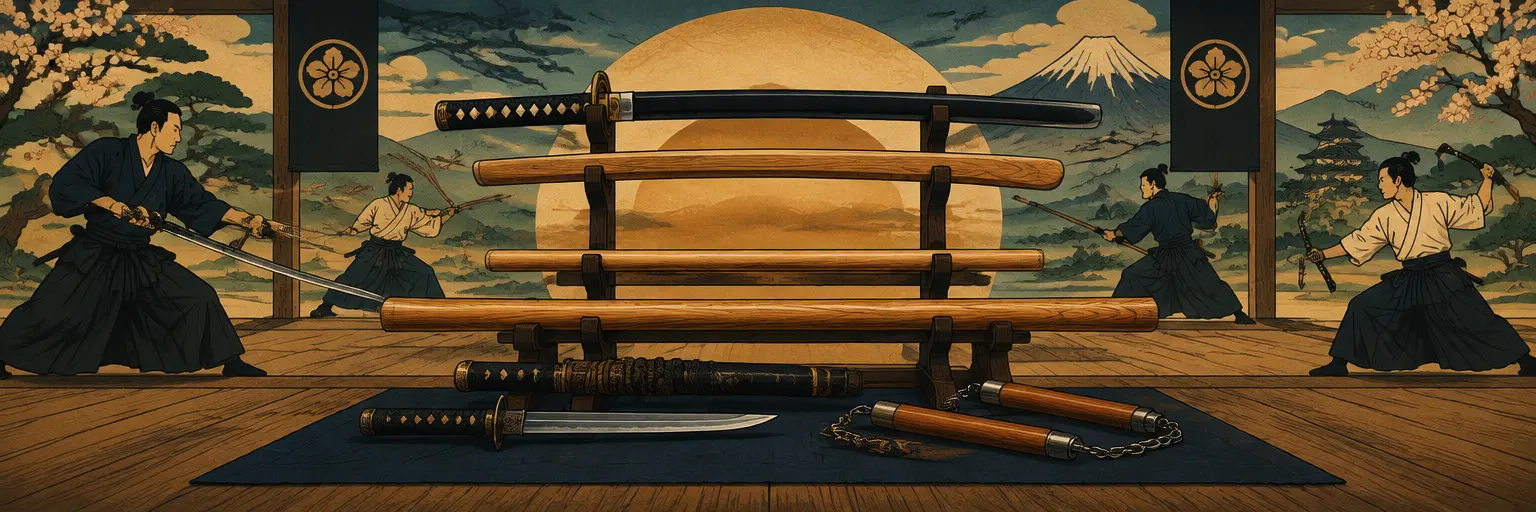
Discover the timeless artistry and discipline of Japanese weaponry, where every blade and staff embodies centuries of martial tradition. From the iconic katana, revered for its razor-sharp elegance and samurai legacy, to the versatile bokken and bo, perfect for honing precise strikes and fluid footwork, this study delves into the soul of classical combat. Explore the compact tanto for close-quarters mastery, the rhythmic power of the nunchaku, and the balanced extension of the jo—each weapon a doorway to deeper focus, coordination, and respect for the warrior’s path. Whether you’re a seasoned practitioner or a curious enthusiast, uncover the historical context, training methods, and philosophical depth that make these tools timeless symbols of martial excellence. Embark on a journey where form meets function, and every movement tells a story of honor, skill, and inner strength.
⚔️ Unlock the secrets to a gleaming, enduring sword with our essential Katana maintenance tips for beginners. Discover the art of preserving…
Read article
⚔️ Elevate your practice with advanced bokken training techniques. MartialArtsMastery.org delves into sophisticated weapon mastery, offering seasoned practitioners the insights needed to…
Read article
💥 Master Bo staff sparring drills and safety protocols on MartialArtsMastery.org. Hone realistic techniques and ensure secure training for peak performance in…
Read article
🗡️ Uncover the profound skill behind the Japanese katana tameshigiri technique. Explore how test cutting reveals the true essence of swordsmanship and…
Read article
💪 Unlock lightning-fast reactions and balanced skill with nunchaku drills. Master these techniques to significantly improve reflexes and develop superior ambidexterity, essential…
Read article
⚔️ Embark on your swordsmanship journey with MartialArtsMastery.org's guide to selecting the best katana for beginners. Navigate essential features, ensuring your first…
Read article
⚔️ Explore the rich Bokken history and techniques beyond its basic form. This article delves into the significance and evolution of the…
Read articleWelcome to our comprehensive exploration of traditional Japanese weaponry, a cornerstone of the Martial Arts Mastery curriculum. This subcategory delves into the iconic tools of the samurai and the budo arts, offering a balanced blend of historical context, practical technique, and philosophical significance. Whether you are a seasoned practitioner or a curious enthusiast, you will gain actionable insights into six essential weapons: the katana, bokken, jo, bo, tanto, and nunchaku. Expect detailed breakdowns of form, grip, footwork, and application, all grounded in authentic tradition and designed to elevate your understanding of martial arts weapons study.
The katana, often called the “soul of the samurai,” is a curved, single-edged blade renowned for its cutting efficiency and symbolic weight. In this section, you will learn about its metallurgy, including the differential hardening that creates the *hamon* (temper line), and how this affects practical use. We cover fundamental stances (*kamae*), drawing techniques (*nukitsuke*), and cutting mechanics (*tsuki* and *kesa-giri*) that emphasize hip rotation and body alignment over arm strength. Expect guidance on proper maintenance, *iai* practice, and how to safely integrate dry-run forms before any partner drills.
Beyond physical technique, the katana study here includes its role in *bushido*—the warrior’s code—and how respect for the blade translates to discipline in training. You’ll discover the anatomy of the weapon, from the *tsuka* (handle) to the *kissaki* (tip), and why balance point matters. For collectors, we also clarify the difference between authentic *nihonto* and practical replicas, ensuring you make informed choices. This is foundational knowledge that enriches every other weapon in the Japanese arsenal.
The bokken (wooden sword) and jo (short staff) are central to *aikido* and *kendo* training, serving as safe yet effective tools for developing precision, speed, and sensitivity. In the bokken curriculum, we teach suburi (basic swings), paired kata like *kumitachi*, and defensive angles that mimic the katana without its lethal edge. For the jo, you will learn its 5-foot length advantage, spinning controls, and *tsuki* thrusts that flow seamlessly with empty-hand techniques. Both tools emphasize *ma-ai* (distance management) and rhythm—critical skills for any martial artist.
These wooden weapons are not mere training substitutes; they are independent systems of combat. The jo, for instance, was famously used by the swordsman Musashi against a dozen opponents, and we dissect that historical scenario to extract practical principles. Expect drills that challenge your footwork, grip relaxation, and breath control. By mastering the bokken and jo, you build a transferable skill set that improves your empty-hand defense and weapon retention, while also deepening your appreciation for Japanese movement aesthetics.
The bo (6-foot staff), tanto (dagger), and nunchaku (flail) represent a diverse spectrum of reach and utility. For the bo, we cover angular blocks, sweeping strikes, and end-to-end reversals that maximize momentum—essential for *kobudo* practitioners. The tanto focuses on close-quarter thrusting, reverse-grip slashes, and defensive responses against grabs, often used in *aikido*’s *tanto-dori* (dagger defenses). The nunchaku, popularized by Bruce Lee, demands wrist flexibility and precise timing; our lessons break down figure-eight patterns, butterfly spins, and safe disarming techniques to prevent self-injury.
What makes this trio unique is their accessibility. A bo can be improvised from a broomstick, a tanto from a hard-backed book, and a nunchaku from household items—though we stress proper gear for safety. We also contextualize each weapon’s historical role: the bo as a peasant’s defense, the tanto as a backup or ritual tool (*seppuku*), and the nunchaku as a threshing implement turned combat asset. Expect progressive training plans that move from solo forms to paired drills, always emphasizing control over flashy tricks. By the end, you will see these weapons as extensions of your body, not just historical relics.
Understanding when and why these weapons were developed enriches your practice. This section covers the feudal era’s social hierarchy, where the katana symbolized status, while the jo and bo equipped monks and commoners. We explore the transition from battlefield combat to refined *budo* arts in the peaceful Edo period, which transformed weapons training into a path of self-cultivation. You’ll learn how *kata* (forms) preserve combat logic and why repetitive practice builds “muscle memory” beyond mere rote copying. This historical lens provides the “why” behind every movement, making your training more intentional.
Philosophically, these weapons embody principles like *mushin* (no-mind) and *zanshin* (remaining awareness). We explain how to cultivate these states through focused drills, breathing, and meditation. Practical advice includes setting up a safe training space, using protective gear, and respecting your training partners. We also address common misconceptions—such as the myth that the nunchaku is an easy weapon—by offering corrective drills. This section is designed to turn technique into wisdom, ensuring that your weapon study contributes to overall martial artistry rather than just trick moves.
From purchasing your first bokken to caring for a genuine katana, this section is your practical guide. We compare materials: white oak versus red oak for bokken, ash for jo, and carbon steel versus alloy for tanto and nunchaku. Maintenance tips include oiling blades, checking rattan wraps, and storing wooden weapons away from humidity to prevent warping. Safety precautions are non-negotiable—always use targets responsibly, keep training areas clear, and never swing heavy weapons near mirrors or people. We also include warm-up routines to protect wrists, elbows, and shoulders, which are most vulnerable in weapon work.
For beginners, we recommend starting with the bokken or jo due to their forgiving nature, then progressing to the katana once fundamentals are solid. Advanced practitioners will find nuanced advice on sharpening, edge alignment, and partner drills with padded tanto or foam nunchaku for realistic feedback. We also discuss testing your skill through solo performance and informal sparring, always emphasizing control and etiquette. Whether you’re aiming for competition, self-defense, or personal growth, these guidelines ensure longevity and joy in your practice.
No, a real katana is not safe for beginners. Start with a bokken or an *iaito* (unsharpened metal blade) to learn form and control without injury risk. Only handle a live blade under a qualified instructor’s supervision after mastering fundamental cuts and stances. Always store securely away from children.
Yes, but patience is key. Begin with a foam or soft rubber nunchaku and practice slow, deliberate swings in an open space. Focus on grip relaxation and wrist rotation, not speed. Progress gradually to wooden or metal models only after you can control the trajectory consistently.
The bo is typically 6 feet long, providing greater reach for sweeping strikes and thrusts, while the jo is about 4 feet, offering quicker, more versatile movements that blend with empty-hand techniques. The jo is often used in aikido for close- to mid-range combat, whereas the bo excels at longer distance and circular momentum.
A teacher is highly recommended for correct form and safety, especially for the katana and nunchaku. However, self-study with quality video tutorials, mirrors, and slow practice is possible for bokken and jo basics. Always supplement with a partner for feedback and avoid live blades until professionally guided.
These weapons teach distance management, body mechanics, and situational awareness that transfer directly to empty-hand defense. The bo can be improvised from a stick or umbrella, the tanto from a pen. More importantly, the training improves confidence and reaction time, though one should never rely on a weapon they are not trained to use legally.