Unlocking the Science of Submission: The Biomechanics of Grappling
Welcome to the foundational pillar of effective grappling, where raw strength meets intelligent physics. At Martial Arts Mastery, we break down the complex interplay of anatomy, force, and movement that separates dominant grapplers from those who merely struggle. This subcategory dives deep into the principles of leverage and control, showing you exactly why certain positions work and how to apply mechanical advantages to your advantage. Whether you are a beginner in Brazilian Jiu-Jitsu, judo, or wrestling, understanding these biomechanical truths will accelerate your skill acquisition, prevent injury, and transform your technical game from muscle-based to precision-based. Here, we turn theory into practical, mat-ready intelligence.
🦴 Functional Anatomy for Grapplers: Knowing Your Levers
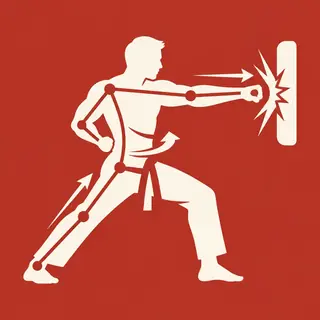
Before you can bend an opponent to your will, you must understand the levers they are built from. This section focuses on the skeletal and muscular systems as they relate to grappling mechanics. We explore how the hip joint, spine, and shoulder complex act as fulcrums for powerful movements. You will learn to identify the strongest angles for your limbs and the weakest for your opponent, ensuring your grips and pressure targets vulnerable joint kinetics rather than fighting muscle bulk directly.
Expect clear breakdowns of joint torque, muscle activation patterns, and the crucial difference between pushing force and pulling force in a clinch. We cover how to align your bones for maximum structure, allowing you to support weight effortlessly and generate unbreakable frames. This anatomical awareness is your first step toward moving like a skilled grappler—flowing around resistance instead of smashing through it, which conserves energy and reduces wear and tear on your own body.
⚖️ The Physics of Pressure: Creating Unbalanced Angles
Pressure is not about how heavy you are; it is about how effectively you transmit your mass onto a smaller, weaker point of your opponent. Here, we decode the physics of force distribution, center of gravity, and base of support. You will discover the secrets of floating pressure versus static weight and how to shift your hips to create an ever-changing, overwhelming force that exhausts your opponent both physically and mentally.
This section provides practical drills to master angle creation—the art of moving your body to break an opponent's posture. We analyze how simple adjustments to your hip height and shoulder orientation multiply your effective strength. By understanding Newton’s third law in a grappling context, you will learn to redirect incoming momentum, off-balance opponents with minimal effort, and use their own force against them, turning defense into immediate offensive attacks.
🔗 Control Systems: From Pins to Submissions
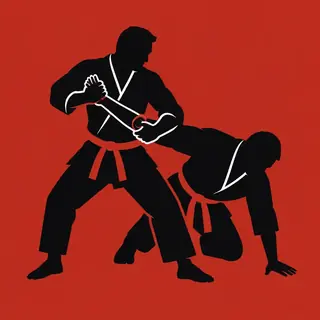
Control is the bridge between a dominant position and a finished fight. This facet of biomechanics focuses on the wiring of the human body—how to use your limbs to isolate segments and restrict movement. We break down the mechanics of the cross-face, the hip clamp, and the underhook, explaining the biomechanical "keys" that lock an opponent into a vulnerable position. Learn to establish positional control that feels like being wrapped in chains, regardless of your size.
Discover the concept of mechanical advantage in submission holds, such as the lever arm of an armbar or the rotational torque of a kimura. We dissect how leverage multiplies the force of your small forearms into painful, joint-threatening pressure. This content emphasizes that submissions are not about squeezing harder but about extending the joint in a direction it cannot go, using your entire body as a fulcrum. Master these biomechanical controls, and escapes become geometrically impossible for the untrained.
🧠 Mat Awareness and Reactive Movement
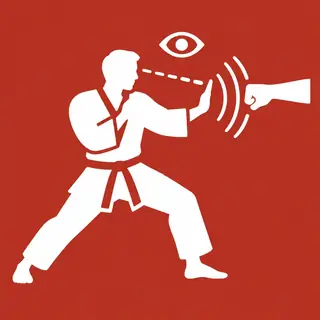
Biomechanics is not static; it is applied in a dynamic, flowing environment. This section bridges the gap between theory and live sparring, focusing on kinesthetic awareness and the reflexes that make techniques instinctive. We teach you to feel the subtle shifts in an opponent's weight, predict their base changes, and time your leverage to the exact millisecond of their movement. This "mat iq" is the highest expression of grappling biomechanics.
Expect to learn visual and tactile cues that signal an off-balance moment, allowing for seamless transitions from guard to sweep or from pass to back take. We cover the efficient use of base and posture in motion, showing you how to always maintain your own structure while sabotaging theirs. Through specific reaction-drill sequences, you will develop the neural pathways to execute high-percentage moves under pressure, turning conscious knowledge into unconscious, fluid skill.
💪 Injury Prevention Through Safe Mechanics
Effective biomechanics protects you as much as it controls others. This crucial section addresses the ergonomics of safe grappling, teaching you how to load your joints and spine correctly to avoid chronic injuries. We examine the common mechanical errors that lead to knee, shoulder, and lower back problems, and provide corrective techniques for posture, bridging, and rolling that keep your body resilient for decades of training.
You will learn how to use structural alignment to safely absorb pressure from a heavy opponent and how to execute falls and breakfalls without risking impact injuries. This includes understanding the role of core tension and intra-abdominal pressure as a natural lifting belt. By mastering these biomechanical safeguards, you not only extend your grappling career but also enhance your performance, as a pain-free and confident body moves with far greater speed, power, and precision.
Frequently Asked Questions
What is the most important biomechanical principle for a beginner grappler?
The most critical concept is maintaining a low, wide base of support. Keep your center of gravity close to the mat and your feet planted wider than your shoulders to resist being easily taken down. This foundational principle allows for efficient balance and makes it harder for opponents to off-balance you, setting the stage for all other leverage applications.
Do I need to be strong to use leverage effectively?
No, but you must move intelligently. Leverage is designed to amplify existing strength, not replace it. Proper technique uses bone structure and angles to multiply force, meaning average strength can overcome much larger opponents. However, basic physical conditioning and core stability still help execute positions quickly and sustain pressure over time.
How does understanding biomechanics help with submissions?
Submissions are pure lever systems. Knowing where the fulcrum lies and how to apply torque over a long lever arm (like the forearm) allows you to attack joints with minimal effort. Instead of relying on muscle fatigue, you use precise body positioning to isolate the joint, making the tap inevitable through mechanical perfection, not brute force.
Can biomechanics help me escape from bottom positions?
Absolutely. Escapes are about creating space and changing angles. By understanding frames—using your forearms and shins to create distance from your opponent’s weight—and hip shifting, you can disrupt their balance. This mechanical knowledge allows you to find the weak point in their base and insert your own structure to reverse the position.
Is this information practical for judo and wrestling, or just BJJ?
It is extremely universal. All grappling arts rely on the same human body and physics. Judo throws exploit rotational torque and balance breaking (kuzushi), while wrestling takedowns use leverage and angle creation. Every technique across these disciplines is a biomechanical application, so the principles in this subcategory directly apply to your mat performance.