
The Art of Ukemi in Nage no Kata: Essential Safety and Skill for Uke

Welcome to Martial Arts Mastery, your ultimate resource for exploring the depths of martial arts!
Ever wondered how to fall safely and effectively, turning a potentially devastating impact into a display of control and resilience? This article delves into the crucial Ukemi technique safety practice within Nage no Kata, uncovering the secrets to mastering this fundamental skill. Prepare to unlock a deeper understanding of how proper Ukemi not only protects you, but also enhances your overall martial arts proficiency. Intrigued? Read on to discover the nuances and practical applications of this essential art!
- Understanding Ukemi: The Foundation of Safe Judo Practice in Nage no Kata
- Types of Ukemi Techniques for Nage no Kata
- Mastering Mae Ukemi: Protecting Yourself During Forward Throws
- Mastering Ushiro Ukemi: Safe Back Fall Techniques for Judo Training
- Mastering Yoko Ukemi: Preventing Injury from Sideways Throws
- Mastering Zenpo Kaiten Ukemi: The Rolling Breakfall for Advanced Throws
- Ukemi Technique Safety Practice: Drills and Exercises for Beginners
- Advanced Ukemi Drills and Variations for Nage no Kata
- The Importance of Consistent Ukemi Training for Uke
- Ukemi Technique: Common Mistakes and How to Correct Them
- Ukemi in Nage no Kata: Enhancing Your Judo Journey
-
Frequently Asked Questions
- What is Ukemi and why is it important in Nage no Kata?
- How does proper Ukemi technique contribute to Uke's skill development?
- What are the different types of Ukemi practiced in martial arts?
- What are some common mistakes practitioners make when learning Ukemi?
- Where can I find resources to improve my Ukemi technique safety practice?
- Final Reflection: Embracing the Fall, Mastering the Art
- Master Ukemi: Elevate Your Nage no Kata Journey!
Understanding Ukemi: The Foundation of Safe Judo Practice in Nage no Kata
Ukemi, often translated as "receiving the body" or "breakfall," is arguably the most critical skill a judoka must master, especially when practicing forms like Nage no Kata. While Nage no Kata focuses on perfecting throwing techniques (nage waza) as performed by Tori (the one executing the throw), its safe and effective execution relies heavily on the proficiency of Uke (the one receiving the throw).
Without skilled Ukemi, the powerful throws demonstrated in the kata would be incredibly dangerous, making Ukemi technique safety practice not just a supplementary exercise but a fundamental requirement. It transforms a potentially harmful fall into a controlled, impact-absorbing maneuver.
The importance of Ukemi extends beyond just receiving throws; it cultivates body awareness, resilience, and confidence. In Nage no Kata, Uke must react predictably and safely to a series of pre-arranged throws. This requires not only knowing how to fall but also anticipating the direction and nature of the fall based on Tori's technique.
Effective Ukemi technique safety practice ensures that Uke can perform their role repeatedly and safely, allowing Tori to practice the kata's precise movements and principles without causing injury. It's a symbiotic relationship where both partners' skills contribute to the safe and successful performance of the kata.
What is Ukemi and Why is it Crucial for Uke?
Ukemi is the art and science of falling safely. It involves specific techniques to absorb the impact of a fall, distribute the force over a larger surface area of the body, and protect vulnerable parts like the head, spine, and joints. For Uke in Nage no Kata, Ukemi is the primary means of survival. Without proper Ukemi, being thrown by techniques like O Soto Gari or Ippon Seoi Nage could result in serious injury due to the forces involved. A throw from standing height can generate impact forces several times the Uke's body weight if the fall is uncontrolled.
The cruciality of Ukemi for Uke lies in its direct link to safety and the ability to participate fully in training. Consider the demonstration of the first set of Nage no Kata, Te Waza (Hand Techniques). Techniques like Tai Otoshi involve Tori sweeping Uke's leg and pulling them forward and down.
Uke must execute Mae Ukemi (front fall) or Yoko Ukemi (side fall) depending on the specific execution. If Uke stiffens up or fails to absorb the impact correctly by slapping the mat and tucking their head, the full force of the fall is transferred directly to their joints or head, risking sprains, dislocations, or concussions. Therefore, dedicated Ukemi technique safety practice is non-negotiable for anyone taking on the role of Uke.
The Role of Ukemi in Preventing Injuries During Judo Throws
Ukemi plays a pivotal role in mitigating the inherent risks associated with Judo throws. The core principle is to dissipate the energy of the fall. This is primarily achieved through the "slap" – striking the mat with the arm(s) just before or upon impact. This action serves multiple purposes: it helps to break the fall, absorbs some of the kinetic energy, and signals to the brain that impact is imminent, allowing the body to prepare. Furthermore, proper body positioning, such as curling the body slightly or tucking the chin, protects the head and spine from direct impact.
Statistical data, while varying by source and dojo, consistently shows that inadequate Ukemi is a significant factor in Judo training injuries. For instance, studies on Judo injuries often highlight sprains (ankle, knee, shoulder) and contusions as common occurrences, many of which can be directly linked to poor falling technique.
Head injuries, though less frequent, are the most severe risk and are often a result of failing to protect the head during a fall, emphasizing the life-saving aspect of diligent Ukemi technique safety practice. By consistently practicing and perfecting their Ukemi, Uke significantly reduces the likelihood and severity of these injuries, ensuring a longer, safer, and more productive Judo journey.
Types of Ukemi Techniques for Nage no Kata
Nage no Kata involves throws in various directions, necessitating Uke's mastery of different breakfall techniques. Each Ukemi type is designed to safely handle impact from a specific direction of fall, ensuring Ukemi technique safety practice covers all necessary scenarios presented in the kata. Understanding when and how to apply each type is fundamental for Uke's role.
The primary Ukemi techniques utilized in Nage no Kata correspond directly to the direction Tori throws Uke. These include falling forward (Mae Ukemi), backward (Ushiro Ukemi), sideways (Yoko Ukemi), and executing a roll (Zenpo Kaiten Ukemi). While all involve absorbing impact, the mechanics differ significantly based on the body's orientation to the ground and the momentum generated by the throw. Proper execution of each is essential for maintaining safety and fluidity throughout the kata.
Mae Ukemi: Front Fall Breakfall Technique
Mae Ukemi is the technique used to fall safely forward. It is crucial when thrown by techniques that send Uke directly forward or forward and slightly sideways, such as Tai Otoshi or Seoi Nage in Nage no Kata. The goal is to distribute the impact across the forearms and chest while protecting the head and face.
Executing Mae Ukemi involves falling forward, extending the arms slightly bent to the sides (roughly 45-degree angle from the body), and striking the mat with the forearms and hands simultaneously with the chest and abdomen making contact. The head must be turned to one side or lifted slightly to avoid hitting the mat. This coordinated impact absorption is key to effective Mae Ukemi technique safety practice.
Ushiro Ukemi: Back Fall Breakfall Technique
Ushiro Ukemi is the technique for falling safely backward. This is used when thrown by techniques that send Uke directly backward, such as De Ashi Harai or Okuri Ashi Harai (sweeps that often result in a backward fall, though these specific techniques aren't in Nage no Kata's core sets, the principle applies to any backward momentum). It is also fundamental practice for general Judo safety. The primary goal is to protect the spine and head.
To perform Ushiro Ukemi, as you fall backward, you curl your body slightly into a C-shape, tucking your chin towards your chest to protect your head. Just before your back hits the mat, you strike the mat forcefully with both arms, held slightly away from the body, palms down. This arm slap helps to absorb the impact and prevent the head from snapping back. Consistent Ushiro Ukemi technique safety practice builds the reflex to tuck the chin and slap the mat automatically.
Yoko Ukemi: Side Fall Breakfall Technique
Yoko Ukemi is the technique for falling safely to the side. This is perhaps the most frequently used Ukemi in Judo randori and is common when thrown by techniques that rotate Uke to the side, such as O Soto Gari, O Uchi Gari, or Harai Goshi – all prominent techniques in Nage no Kata. The objective is to absorb the impact along the side of the body while protecting the head and opposite arm.
In Yoko Ukemi, as you fall to your side, the arm on the side you are falling towards strikes the mat forcefully at an angle (around 45 degrees from the body, palm down) just before your body makes contact. The body should be slightly curved, and the head lifted or turned away from the impact side. The other arm can rest across the chest. Mastering Yoko Ukemi technique safety practice is vital for Uke in Nage no Kata due to the prevalence of sideways-throwing techniques.
Zenpo Kaiten Ukemi: Rolling Breakfall Technique
Zenpo Kaiten Ukemi is a rolling breakfall used when the momentum of the throw sends Uke forward in a tumbling motion. This is often seen with techniques like Tomoe Nage or Sumi Gaeshi, which are part of Nage no Kata's Sutemi Waza (Sacrifice Techniques) sets. Instead of a static fall, this technique involves rolling over the shoulder and back to dissipate the energy of the throw.
Performing Zenpo Kaiten Ukemi requires initiating a forward roll, typically over one shoulder, tucking the head securely against the chest or towards the rolling shoulder. The impact is absorbed by rolling smoothly across the back from one shoulder to the opposite hip. A slap with the hand on the side of the roll may accompany the end of the roll to further absorb residual energy. Zenpo Kaiten Ukemi technique safety practice focuses on developing a fluid, controlled roll that minimizes direct impact.
Mastering Mae Ukemi: Protecting Yourself During Forward Throws
Mastering Mae Ukemi is essential for Uke, particularly when facing forward-throwing techniques in Nage no Kata like Tai Otoshi or Ippon Seoi Nage. This technique is fundamental for Ukemi technique safety practice in scenarios where Tori's kuzushi (unbalancing) sends Uke forward and down. The goal is to create a large surface area upon landing and protect the head and face.
Effective Mae Ukemi involves timing the fall correctly with the throw, ensuring the body remains relatively relaxed to absorb shock, not stiff. The arms, extended slightly, act as initial shock absorbers, and the simultaneous impact of forearms, chest, and abdomen distributes the force. The head must be actively protected by turning it to the side or lifting the chin away from the mat. Consistent practice builds the muscle memory required for this coordinated action.
Proper Body Positioning for Safe Mae Ukemi
Proper body positioning in Mae Ukemi is critical for safety and effective impact absorption. As you fall forward, your body should ideally maintain a slight curve, preventing a rigid, plank-like impact. Your arms should be extended forward and outward at roughly a 45-degree angle from your body, not straight out in front (which risks wrist/elbow injury) or tucked in (which reduces impact absorption).
The head position is paramount: never allow your forehead or face to hit the mat. This is achieved by turning your head to one side or lifting your chin towards your chest. The impact should be taken across the forearms, palms, chest, and abdomen simultaneously. This distributes the force over a significant area, reducing the pressure on any single point. Maintaining this posture throughout the fall is a core element of Mae Ukemi technique safety practice.
Key Techniques for Executing Mae Ukemi Effectively
Executing Mae Ukemi effectively relies on timing, relaxation, and coordinated action. The timing involves initiating the breakfall just as your center of gravity becomes unstable and you are committed to the fall. Relaxation is counter-intuitive but vital; a stiff body absorbs shock poorly, like a rigid rod. A slightly relaxed body allows for better energy dissipation.
The coordinated action involves extending the arms, positioning the head, and preparing the body for the simultaneous impact. The "slap" with the forearms and hands should be forceful and occur precisely as the chest/abdomen contact the mat. This slap helps to slow the descent and absorb a significant portion of the impact energy. Repeated drills focusing on this coordinated timing and relaxation are key to solid Mae Ukemi technique safety practice.
Common Mistakes to Avoid in Mae Ukemi Practice
Several common mistakes can compromise safety during Mae Ukemi. One of the most dangerous is failing to protect the head, either by not tucking the chin or not turning the head, leading to head impact. Another common error is landing with straight, locked elbows or wrists, which can cause sprains or fractures. Some beginners also land with their arms too close to their body, failing to use them effectively for impact absorption.
Stiffening the body during the fall is another frequent mistake; the body should be relatively relaxed to absorb the shock. Landing like a rigid board concentrates the impact. Finally, failing to slap the mat forcefully enough reduces the technique's effectiveness in dissipating energy. Identifying and correcting these errors through focused Ukemi technique safety practice and feedback from an instructor is essential for developing reliable Mae Ukemi.
Mastering Ushiro Ukemi: Safe Back Fall Techniques for Judo Training
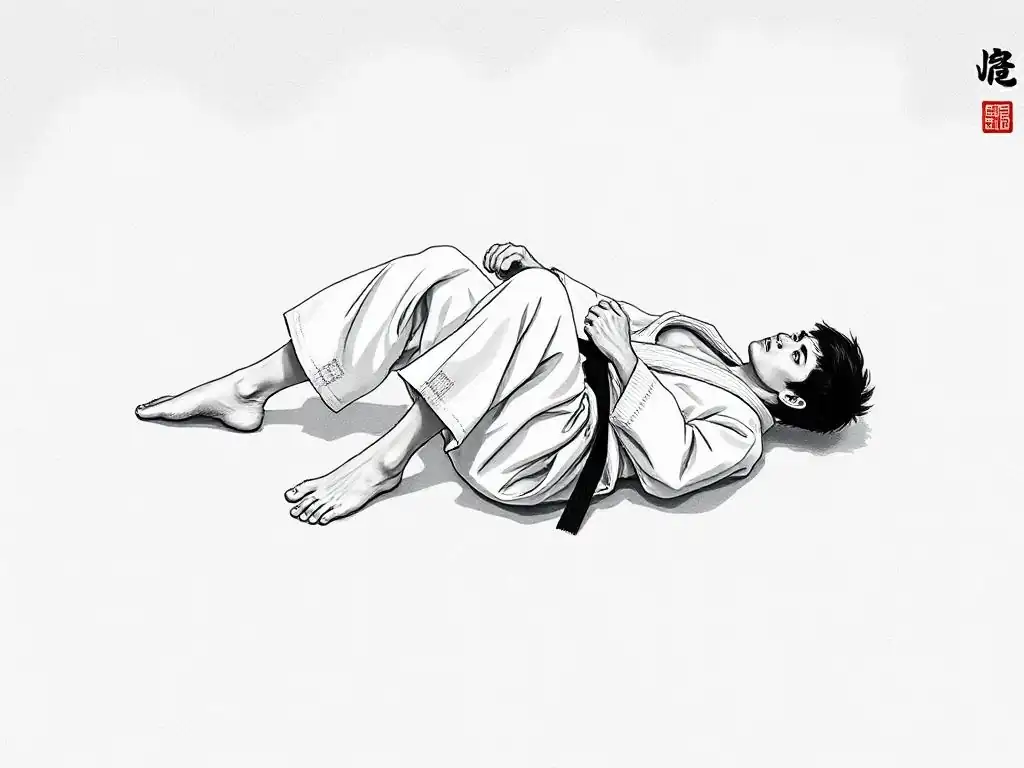
Ushiro Ukemi is the fundamental back fall technique, crucial for safety in Judo training and applicable in situations where Uke is thrown or loses balance backward. While not as frequently demonstrated in the formal Nage no Kata sets as side or front falls, understanding and practicing Ushiro Ukemi is a foundational element of overall Ukemi technique safety practice and prepares Uke for unexpected backward momentum.
The core principle of Ushiro Ukemi is protecting the head and spine by rounding the back and using the arms to break the fall just before the back hits the mat. The action of tucking the chin is perhaps the single most important detail, preventing the head from striking the ground.
Perfecting Your Posture for Ushiro Ukemi
Perfecting the posture for Ushiro Ukemi involves creating a slightly rounded shape with your back as you fall. This is achieved by pulling your knees towards your chest and tucking your chin firmly. Imagine trying to look at your belt or navel. This curvature helps the impact to roll along the curve of your back rather than hitting one spot rigidly.
Maintaining this tucked chin position throughout the fall is paramount. Even a slight lapse can result in the back of the head hitting the mat, which is extremely dangerous. The arms should be positioned slightly away from the body, ready to strike the mat. This tucked, rounded posture is the cornerstone of effective Ushiro Ukemi technique safety practice.
The Importance of Arm Placement in Ushiro Ukemi
Arm placement is critical in Ushiro Ukemi for both absorbing impact and protecting the head. As you fall backward, your arms should be extended out to the sides, roughly at a 45-degree angle from your body, palms down. Just before your back makes contact with the mat, you forcefully slap the mat with the entire length of your arms, from hand to shoulder.
This simultaneous, forceful slap serves to dissipate a significant amount of the fall's energy. It also helps to prevent the head from snapping back and hitting the mat. If the arms are held too close to the body, they cannot effectively break the fall. If they are too far overhead, they offer less protection and the slap is less effective. Precision in arm placement and timing the slap is key to successful Ushiro Ukemi technique safety practice.
Drills for Improving Your Ushiro Ukemi
Improving Ushiro Ukemi proficiency requires focused drills. Simple exercises can begin from a seated position, practicing tucking the chin and rolling backward slightly while slapping the mat. Progressing from a kneeling position to falling backward onto the mat while maintaining the tucked chin and executing the arm slap builds confidence and muscle memory.
Another effective drill involves starting from a squatting position, then sitting down and immediately rolling backward into Ushiro Ukemi. Partner drills can involve a partner gently pushing you backward from a standing or kneeling position, prompting the Ushiro Ukemi response. Consistent repetition of these basic drills is fundamental to solidifying Ushiro Ukemi technique safety practice.
Mastering Yoko Ukemi: Preventing Injury from Sideways Throws
Yoko Ukemi, the side fall breakfall, is arguably the most frequently used Ukemi in dynamic Judo practice and is essential for receiving many of the throws in Nage no Kata, such as O Soto Gari, Harai Goshi, and Uchi Mata. Mastering this technique allows Uke to safely absorb the impact of being thrown to the side, which is a common outcome in Judo.
The principle of Yoko Ukemi involves distributing the impact along the side of the body and using the arm on the falling side to break the fall. Protecting the head by lifting it or turning it away from the impact side is non-negotiable. Effective Yoko Ukemi technique safety practice ensures that Uke can withstand repeated sideways throws without injury.
Understanding the Mechanics of Yoko Ukemi
The mechanics of Yoko Ukemi involve a coordinated action of the body and the striking arm. As you are thrown sideways, you fall onto one side of your body (hip, rib cage, shoulder). Simultaneously, the arm on that same side is extended out and strikes the mat forcefully. The body should be slightly curved, not rigid.
The slap should occur just before or as the main part of your body (hip/rib cage) contacts the mat. This timing is crucial for dissipating energy effectively. The head must be actively kept off the mat. Understanding this sequence and the role of each body part is the first step in mastering Yoko Ukemi technique safety practice.
Using Your Hand and Arm for Support in Yoko Ukemi
In Yoko Ukemi, the arm on the falling side serves as the primary impact absorber. It is extended out at roughly a 45-degree angle from the body, palm down. The strike should involve the entire length of the arm, from the fingertips to the shoulder making contact with the mat forcefully.
The force of the slap helps to absorb the energy of the fall, preventing it from being fully transmitted through the body. The hand and arm placement also helps to stabilize the fall and prevent uncontrolled bouncing. Learning to generate a strong, flat slap with the forearm and hand is a key component of effective Yoko Ukemi technique safety practice.
Practice Exercises for Yoko Ukemi Proficiency
To build proficiency in Yoko Ukemi, start with simple exercises. Sitting on the mat, practice falling directly to your side, tucking your head and slapping forcefully with the appropriate arm. Progress to falling from a kneeling position, then from a squatting position.
Partner drills are excellent for practicing Yoko Ukemi technique safety practice in a more dynamic context. A partner can gently push you off balance to the side, prompting you to execute the breakfall. Gradually increase the height and momentum of the "fall" as your confidence and skill grow. Practicing from various stances and with slight movement simulates real throwing scenarios more closely.
Mastering Zenpo Kaiten Ukemi: The Rolling Breakfall for Advanced Throws
Zenpo Kaiten Ukemi, the forward rolling breakfall, is essential for safely receiving sacrifice techniques (Sutemi Waza) in Nage no Kata, such as Tomoe Nage or Sumi Gaeshi, where Tori throws themselves backward to throw Uke forward. This technique allows Uke to convert the forward momentum into a controlled roll, dissipating the energy over a larger surface area and preventing direct impact.
Unlike static falls, Zenpo Kaiten Ukemi is a dynamic movement. It requires coordination, flexibility, and the ability to initiate a smooth roll. Mastering this technique is a step up in Ukemi technique safety practice, preparing Uke for the more complex throws found later in Nage no Kata.
When to Use Zenpo Kaiten Ukemi in Nage no Kata
Zenpo Kaiten Ukemi is specifically used in Nage no Kata when receiving techniques from the Sutemi Waza sets, such as Tomoe Nage (circle throw) and Sumi Gaeshi (corner reversal). In these techniques, Tori typically falls backward, pulling or lifting Uke forward and over them.
The momentum generated by these throws propels Uke forward in a way that a simple Mae Ukemi (front fall) would be ineffective and potentially dangerous. The rolling motion of Zenpo Kaiten Ukemi allows Uke to safely absorb this forward and downward momentum by rolling over their shoulder and back, preventing a hard impact on the front of the body or head. Recognizing the type of throw and initiating the correct roll is key to effective Ukemi technique safety practice in these scenarios.
Step-by-Step Guide to Performing Zenpo Kaiten Ukemi
Performing Zenpo Kaiten Ukemi involves several coordinated steps. From a standing or falling position with forward momentum, initiate the roll by tucking your head and leading with one shoulder. Your chin should be firmly tucked towards your chest.
Roll diagonally across your back, from the leading shoulder to the opposite hip. Keep your body relatively rounded. As you complete the roll, you may execute a simultaneous slap with the hand on the side opposite your initial rolling shoulder to help absorb residual energy and regain balance. The movement should be continuous and fluid, avoiding any stops or hard impacts during the roll. Practicing this sequence slowly at first is vital for safe Zenpo Kaiten Ukemi technique safety practice.
Tips for Smooth and Controlled Rolling Breakfalls
Achieving smooth and controlled Zenpo Kaiten Ukemi requires attention to detail. Ensure your head is securely tucked throughout the roll to avoid hitting the back of your head. Maintain a rounded shape with your back; avoid rolling like a stiff log.
Focus on rolling diagonally across your back, not straight over your spine. This distributes the impact more effectively. Practice the roll slowly without any throw initially to get comfortable with the motion. Gradually increase the speed and add momentum. Breathing out during the roll can help with relaxation and control. Consistent, mindful practice of these tips is crucial for mastering Zenpo Kaiten Ukemi technique safety practice.
Ukemi Technique Safety Practice: Drills and Exercises for Beginners
Beginning Ukemi technique safety practice is foundational to learning Judo safely. Beginners should start with simple, low-impact drills to build confidence and muscle memory before progressing to practicing with throws. The focus should be on learning the correct body positions, head protection, and the timing of the mat slap for each basic Ukemi type.
Starting slowly and progressively is key. Attempting to practice Ukemi from high falls or powerful throws too early can lead to fear and injury. A structured approach focusing on repetition of basic movements ensures that the essential elements of safe falling become automatic reflexes.
Warm-up Exercises for Ukemi Training
Before any Ukemi technique safety practice, a proper warm-up is essential to prepare the body. This should include light cardiovascular activity to raise the heart rate and warm the muscles, such as jogging or jumping jacks. Dynamic stretching is also important, focusing on mobility in the shoulders, hips, and spine, which are heavily used in breakfalls.
Exercises like arm circles, torso twists, leg swings, and gentle neck rotations help loosen the joints and muscles involved in the falling and rolling motions. Preparing the body reduces the risk of strains or sprains during practice. A good warm-up sets the stage for effective and safe Ukemi training.
Progressive Drills for Learning Each Ukemi Type
Progressive drills are the backbone of learning Ukemi technique safety practice. For Ushiro Ukemi, start by sitting, then rolling back. For Yoko Ukemi, start by sitting and falling sideways. For Mae Ukemi, start by falling from a kneeling position or even just practicing the arm slap technique while lying face down.
Once comfortable with these basic movements on the spot, gradually introduce height and momentum. Practice falling from a squat, then from standing. Introduce gentle pushes from a partner. For Zenpo Kaiten Ukemi, begin with simple forward rolls on the mat before attempting them from a simulated throw. Each step should build upon the previous one, ensuring the student is comfortable and safe before moving on.
Using Mats and Protective Gear for Safe Ukemi Practice
Using appropriate mats is non-negotiable for Ukemi technique safety practice. Judo mats are designed to absorb impact and provide a safe surface for falling. Practicing on hard surfaces like wood or concrete is extremely dangerous. Ensure the mats are properly laid and there are no gaps.
While not standard in all dojos, some beginners or individuals with specific concerns may opt for additional protective gear, such as mouthguards or light padding, especially when first learning. However, the primary protection comes from the technique itself. Focusing on mastering the correct movements on proper mats is the most effective strategy for safe Ukemi practice.
Advanced Ukemi Drills and Variations for Nage no Kata
Once the basic Ukemi techniques are mastered, advanced drills focus on applying them in more dynamic and realistic scenarios, particularly relevant for the fluidity and timing required as Uke in Nage no Kata. Advanced Ukemi technique safety practice involves reacting to movement, adapting to variations in throws, and developing intuitive responses.
These drills move beyond static falling to incorporate footwork, balance recovery, and the transition from being unbalanced to executing the breakfall. The goal is to make Ukemi a seamless reaction rather than a conscious, delayed decision.
Combining Ukemi with Movement and Footwork
Advanced Ukemi drills often involve movement before the fall. Practice walking or shuffling and then executing a specific Ukemi upon a signal or gentle push. This simulates the loss of balance that precedes a throw in Nage no Kata.
Another drill involves practicing breakfalls after being pulled or pushed while maintaining a stance. This helps Uke get used to falling from different angles and with varying degrees of momentum, improving their Ukemi technique safety practice in dynamic situations. Incorporating footwork patterns from Nage no Kata and practicing breakfalls from those positions enhances readiness for the kata's specific movements.
Reacting to Different Throwing Techniques with Appropriate Ukemi
A key aspect of advanced Ukemi technique safety practice for Nage no Kata is learning to recognize the type of throw being applied and reacting with the appropriate Ukemi instantly. This requires Uke to understand the mechanics of Tori's techniques and anticipate the direction of the fall.
Drills involve a partner initiating various throws slowly, allowing Uke to identify the technique and execute the correct breakfall (e.g., Yoko Ukemi for O Soto Gari, Mae Ukemi for Tai Otoshi, Zenpo Kaiten Ukemi for Tomoe Nage). Gradually increasing the speed and realism of the throw setup improves Uke's reaction time and decision-making under pressure, crucial for performing Ukemi safely and effectively in the kata.
Developing Intuitive Ukemi Skills for Realistic Judo Practice
The ultimate goal of advanced Ukemi technique safety practice is to develop intuitive, reflexive breakfalling skills. This means reacting correctly to a fall without conscious thought. This level of skill is developed through thousands of repetitions and varied practice scenarios.
Training Uke to react to unexpected unbalancing, falls from different heights, and different types of momentum helps build this intuition. This isn't just about Nage no Kata but about overall Judo safety. When Ukemi becomes an automatic response, Uke can focus more on their role in the kata, allowing for a smoother, more authentic performance while maximizing Ukemi technique safety practice.
The Importance of Consistent Ukemi Training for Uke
Consistent Ukemi training is not just about learning to fall; it's about building resilience, trust, and longevity in Judo. For Uke, particularly in the context of Nage no Kata, regular practice ensures that the breakfall techniques remain sharp, reliable, and effective, even under stress or fatigue. It's a skill that diminishes without ongoing refinement.
Integrating Ukemi into every training session, whether through dedicated drills or practicing falls during warm-ups, reinforces the muscle memory and mental preparedness required for safe practice. This commitment to Ukemi technique safety practice benefits not only Uke but also Tori, who can practice their throws with confidence, knowing their partner can fall safely.
Integrating Ukemi into Every Judo Training Session
Making Ukemi practice a routine part of every Judo session is vital. This doesn't mean spending hours solely on breakfalls, but incorporating them into warm-ups, cool-downs, or transitions between other activities. Simple exercises like practicing standing Yoko Ukemi or rolling drills can be done quickly.
During randori or kata practice, maintaining focus on executing proper Ukemi whenever a fall occurs reinforces the habit. Instructors often allocate specific time, perhaps 10-15 minutes per session, purely for Ukemi technique safety practice, recognizing its fundamental importance. This consistent exposure ensures the skills remain sharp and readily available.
The Mental Aspect of Ukemi: Confidence and Resilience
Ukemi training has a profound mental impact. Mastering breakfalls builds confidence by reducing the fear of being thrown. When Uke trusts their ability to fall safely, they are less likely to stiffen up or resist throws in a dangerous manner. This increased confidence allows them to be a better, more relaxed partner for Tori.
Furthermore, repeatedly falling and recovering builds mental resilience. It teaches Uke to handle impact and discomfort and to get back up and continue training. This resilience translates into other aspects of Judo and life. Ukemi technique safety practice is as much about building mental fortitude as it is physical skill.
Long-Term Benefits of Mastering Ukemi in Nage no Kata
Mastering Ukemi offers significant long-term benefits for a judoka, especially one who regularly acts as Uke in Nage no Kata. The most obvious benefit is a reduced risk of injury over years of training. Fewer injuries mean more consistent participation and progress in Judo.
Beyond safety, skilled Ukemi allows Uke to provide better feedback to Tori. A relaxed, responsive Uke who falls correctly allows Tori to feel the true effectiveness of their technique. This mutual improvement accelerates learning for both partners. Ultimately, dedicated Ukemi technique safety practice leads to a more enjoyable, safer, and fulfilling Judo journey.
Ukemi Technique: Common Mistakes and How to Correct Them
Even experienced judoka can develop bad habits in their Ukemi. Identifying and correcting these common mistakes is crucial for maintaining high standards of Ukemi technique safety practice. Awareness of potential errors is the first step towards improvement.
Common errors often involve failing to protect the head, improper arm placement for the slap, stiffening the body, or incorrect timing of the breakfall. These mistakes can significantly reduce the effectiveness of the Ukemi and increase the risk of injury.
Identifying and Addressing Common Ukemi Errors
Identifying Ukemi errors often requires external observation. Common indicators of poor Ukemi include loud, uncontrolled impacts, bouncing after landing, or visible signs of discomfort or pain after a fall. Specific errors for each Ukemi type need targeted correction.
For instance, if the head is hitting the mat during Ushiro Ukemi, the correction focuses intensely on chin tucking drills. If the arm slap is ineffective in Yoko Ukemi, practice generating a stronger, flatter slap. Addressing stiffness involves conscious relaxation techniques and starting with lower-impact drills. Consistent self-assessment and external feedback are vital for improving Ukemi technique safety practice.
Seeking Feedback from Experienced Instructors
Seeking feedback from experienced Judo instructors is invaluable for improving Ukemi. Instructors can spot subtle errors in body positioning, timing, or force generation that a student might not notice themselves. They can provide specific cues and drills tailored to correct individual weaknesses.
Don't be afraid to ask your sensei or a senior student to watch your Ukemi technique safety practice and offer constructive criticism. They have likely corrected these same errors in many students before and can offer insights that accelerate your learning and improve your safety.
The Value of Video Analysis in Improving Ukemi Performance
Video analysis can be a powerful tool for improving Ukemi technique safety practice. Recording yourself performing different breakfalls allows you to see exactly what your body is doing during the fall. It's often surprising to see the difference between what you feel you are doing and what you are actually doing.
Reviewing videos can help identify issues like insufficient chin tucking, incorrect arm angles, or failing to maintain body shape. Comparing your technique to videos of skilled judoka performing Ukemi can highlight areas for improvement. This objective feedback method can significantly enhance your understanding and refinement of breakfall techniques.
Ukemi in Nage no Kata: Enhancing Your Judo Journey
Ultimately, mastering Ukemi technique safety practice is not just about avoiding injury; it's about enriching your entire Judo experience, particularly in the structured environment of Nage no Kata. Skilled Ukemi allows Uke to be a true partner in the kata's performance, enabling Tori to execute techniques with precision and power.
Ukemi is an integral part of the Judo philosophy – the principle of Ju (gentleness or yielding) applied to falling. By yielding to the force of the throw and absorbing it skillfully, Uke embodies a core tenet of Judo.
Ukemi as a Foundation for Advanced Judo Techniques
Strong Ukemi skills provide a solid foundation for learning and practicing more advanced Judo techniques, both as Uke and potentially as Tori. When you are confident in your ability to fall, you are more willing to attempt dynamic throws as Tori, knowing you can recover if you lose balance, and more willing to be thrown with vigor as Uke, enabling Tori's practice.
Furthermore, the body control, balance, and awareness developed through Ukemi technique safety practice are transferable skills that benefit all aspects of Judo, from grappling (Katame Waza) to transitions between standing and ground work (Tachi-waza to Ne-waza).
Building Confidence and Reducing Fear of Throws
As mentioned earlier, perhaps the most significant psychological benefit of dedicated Ukemi technique safety practice is the reduction of the fear of falling and being thrown. This fear is a natural human response, but in Judo, it can be a major impediment to progress and safety.
When Uke knows they can fall safely, they can relax, move more naturally, and react appropriately to techniques in Nage no Kata or randori. This confidence allows for more dynamic practice and a deeper engagement with the art of Judo.
The Art of Falling Gracefully: Ukemi as a Reflection of Judo Principles
Ukemi is often described as the "art of falling gracefully." This isn't just about aesthetics; it reflects the underlying principles of Judo. Falling safely requires yielding to the force, controlling your body, and using technique rather than brute force to manage impact.
In Nage no Kata, Uke's Ukemi is as much a performance of Judo principles as Tori's throw. The controlled, skillful fall demonstrates understanding and mastery of how to receive force effectively. Dedicated Ukemi technique safety practice allows Uke to embody the principles of balance, control, and yielding, making their role in the kata a vital and respected part of the overall demonstration of Judo mastery.
Frequently Asked Questions
What is Ukemi and why is it important in Nage no Kata?
Ukemi is the Japanese term for breakfalls, a crucial safety technique. In Nage no Kata, it's essential for Uke (the receiver of the technique) to safely absorb the impact of throws, preventing injuries.
How does proper Ukemi technique contribute to Uke's skill development?
Mastering Ukemi allows Uke to confidently receive techniques, facilitating realistic and dynamic training. It also enhances their understanding of balance and body mechanics, improving their overall martial arts skill.
What are the different types of Ukemi practiced in martial arts?
Common types include forward roll, backward roll, side breakfall, and forward breakfall. Each type is designed to distribute impact and minimize the risk of injury during specific throws or takedowns.
What are some common mistakes practitioners make when learning Ukemi?
Common errors include tucking the chin improperly, failing to slap the mat correctly, and not maintaining a rounded back. These mistakes can lead to neck injuries, wrist sprains, and back pain.
Where can I find resources to improve my Ukemi technique safety practice?
MartialArtsMastery.org offers articles, videos, and training tips dedicated to Ukemi and other martial arts techniques. Look for content tagged with "Ukemi technique safety practice" for specific guidance.
Final Reflection: Embracing the Fall, Mastering the Art
The journey through the art of Ukemi in Nage no Kata reveals more than just techniques; it unveils a philosophy of resilience and adaptability. The principles of safe falling, once confined to the dojo, resonate powerfully in our daily lives, reminding us that controlled acceptance of inevitable setbacks is key to continued growth and progress. Learning to fall gracefully, both literally and figuratively, empowers us to face challenges with courage and minimizes the impact of life's unexpected tumbles.
This exploration of Ukemi has profoundly influenced my understanding of martial arts and its broader implications. It's not just about avoiding injury; it's about cultivating a mindset of preparedness and control, even in moments of vulnerability. The ability to protect oneself while being thrown, to transform a potentially harmful situation into an opportunity for learning and refinement, is a powerful metaphor for navigating the complexities of life. Fall seven times, stand up eight.
This Japanese proverb perfectly encapsulates the spirit of Ukemi and its enduring relevance.
Now, consider how you can apply the principles of Ukemi to your own life. Are you bracing for impact, or are you learning to flow with the challenges that come your way? Embrace the fall, learn from the experience, and rise stronger than before. The art of Ukemi is not just a martial art technique; it's a life skill, a testament to the human capacity for resilience and the unwavering pursuit of mastery.
Master Ukemi: Elevate Your Nage no Kata Journey!
Thank you for exploring the essential role of ukemi in Nage no Kata. We hope this article has deepened your understanding of how crucial proper falling techniques are for both safety and skill enhancement. Now, it's time to put this knowledge into action!
Here's how you can take your ukemi to the next level:
- Prioritize your safety: Begin practicing each ukemi technique slowly and deliberately, focusing on proper form and controlled movements. Work with a qualified instructor to receive personalized feedback.
- Share this article with your fellow martial artists to spark a discussion and foster a culture of safety and continuous improvement in your dojo.
- Explore our website, martialartsmastery.org , for more in-depth articles and resources on Nage no Kata and related martial arts topics.
Ready to commit to mastering ukemi and unlocking new potential in your Nage no Kata?