The 1964 Tokyo Olympics: Judo's Debut and its Impact on Western Perceptions
🌟 The 1964 Tokyo Olympics marked Judo’s debut on the world stage, significantly shaping Western perceptions of martial arts. This historic event…
Read article
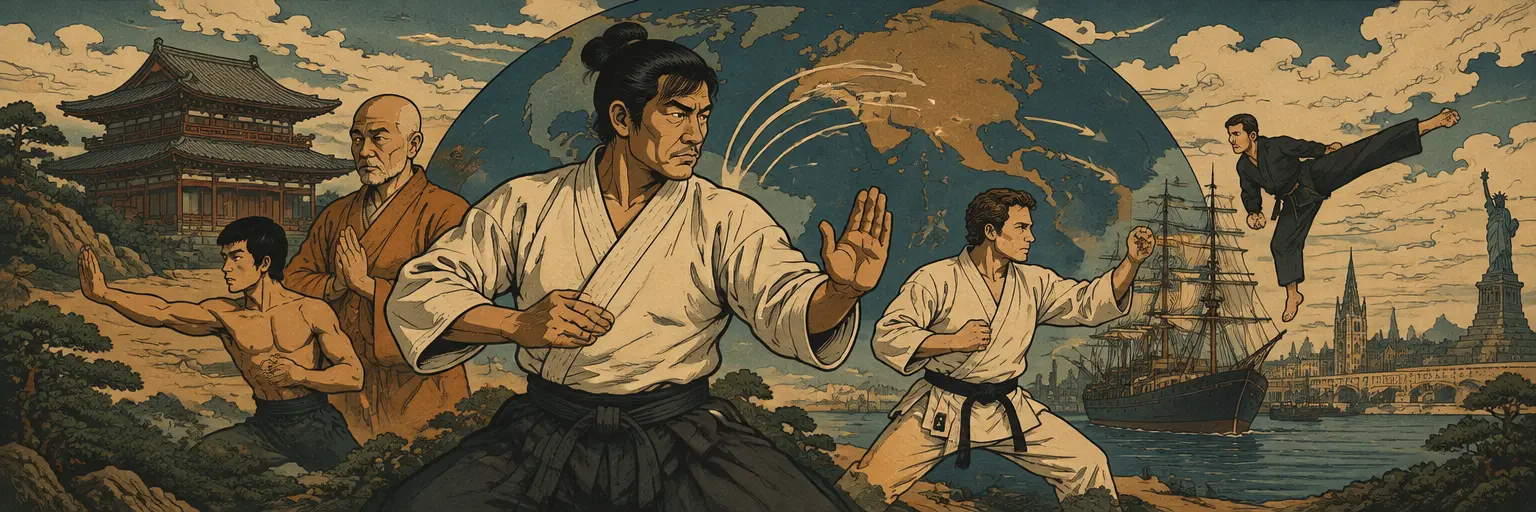
The journey of martial arts from the East to the West is a riveting saga of cultural exchange, driven by charismatic pioneers and pivotal moments that reshaped global fitness and combat philosophy. From Bruce Lee’s electrifying screen presence that ignited a worldwide kung fu craze, to judo’s inclusion in the Olympics and the quiet influence of karate masters in post-war America, this narrative is packed with legendary figures like Jigoro Kano, Mas Oyama, and Chuck Norris. Discover how events such as the Vietnam War, Hollywood cinema, and the rise of Brazilian Jiu-Jitsu in the 1990s (via the Gracie family) transformed ancient disciplines into modern training systems. Here, you’ll explore the key milestones—from early 20th-century immigration to the global explosion of MMA—that turned once-secret techniques into accessible paths for self-defense, fitness, and personal growth. Whether you’re a history buff or a dedicated practitioner, understanding this spread reveals the enduring appeal and adaptability of martial arts in the West.
🌟 The 1964 Tokyo Olympics marked Judo’s debut on the world stage, significantly shaping Western perceptions of martial arts. This historic event…
Read article
🌟 The rise of martial arts tournaments reflects significant growth trends, transforming from local contests into global spectacles. MartialArtsMastery.org explores this evolution,…
Read article
🥋 The Western martial arts lineage challenge lies in preserving authentic techniques amidst modern adaptations. MartialArtsMastery.org explores the delicate balance of maintaining…
Read article
🥋 Discover how Western martial arts masters have embraced Eastern traditions, blending philosophies and techniques to forge new paths in martial arts…
Read article
🥋 Western martial arts legal issues have significantly shaped how practitioners train and use weaponry, imposing restrictions that impact traditional practices. Understanding…
Read article
😊 Western audiences' martial arts appeal lies in their blend of discipline, philosophy, and cinematic excitement, fostering a deep cultural connection and…
Read article
🥋 Discover the Forgotten Masters of Western Martial Arts—unsung teachers whose innovative techniques and philosophies laid the foundation for modern combat sports,…
Read articleThe journey of martial arts from Asia to the Western world is a fascinating saga of cultural exchange, wartime encounters, and cinematic showmanship. This subcategory explores the pivotal individuals and milestone events that transformed karate, judo, taekwondo, and kung fu into global phenomena. From post-war occupation forces to Hollywood blockbusters, you will uncover how these fighting systems evolved beyond their origins to reshape fitness, self-defense, and personal philosophy in the West. Expect to discover the pioneers who risked tradition to teach outsiders, and the competitions that legitimized Eastern combat sports on a world stage.
The modern spread of martial arts owes much to military occupation and the global conflict of World War II. When American and Allied soldiers stationed in Japan, Okinawa, and Korea returned home, they brought with them more than souvenirs; they carried a disciplined practice that had deeply impressed them. Key figures like Robert Trias, who studied in the Pacific and opened the first American karate dojo in Phoenix in 1946, and Donn Draeger, a Marine who later became a prolific author and judo historian, were instrumental in translating these arts for Western eyes. Their early demonstrations and instructional manuals created the first reliable gateway for curious civilians.
These veterans did not simply replicate techniques; they adapted them. The emphasis on kata and kumite was often stripped down to practical self-defense to appeal to a pragmatic Western audience. Simultaneously, the U.S. military began integrating martial arts into its own hand-to-hand combat training, further legitimizing these systems in the public consciousness. This military foundation built a sturdy scaffold upon which later cultural and commercial forces could build a lasting presence for karate, judo, and taekwondo in America and Europe, laying the groundwork for the explosion of interest in the 1960s and 1970s.
Television and international tournaments turned martial arts from a niche pastime into a mainstream spectator sport. The 1964 Tokyo Olympics showcased judo to a global audience for the first time, presenting a formal, sports-based version of the art that was both thrilling and palatable to Western viewers. In parallel, the rise of knockout karate competitions in California, led by figures like Ed Parker and his International Karate Championships (founded in 1963), introduced full-contact spectacle that differed sharply from traditional point-fighting. This event attracted Hollywood stars and created a glamorous aura around high-kicking martial artists.
This era also saw the emergence of influential schools that systematized teaching for non-Japanese or non-Korean students. Hidetaka Nishiyama, a direct student of Funakoshi, established the Japan Karate Association in the U.S., ensuring strict traditional standards. At the same time, Bruce Lee began teaching his personal system, Jeet Kune Do, in Oakland and Los Angeles. His philosophical approach and physical charisma, though short-lived, challenged the orthodoxy of established styles and paved a new path for martial arts as a form of self-expression rather than just a cultural artifact. The media coverage of these tournaments and personalities normalized the practice for millions of Westerners.
No single figure accelerated the global spread of martial arts like Bruce Lee, who fused technical skill with cinematic charisma. His 1973 blockbuster Enter the Dragon became a cultural touchstone, introducing mainstream Western audiences to kung fu’s fluid strikes, philosophical depth, and quick footwork. Prior to this, his role as Kato in The Green Hornet (1966) had already planted the seeds of fascination. Lee’s unique screen presence and his mantra, “Be water, my friend,” captured the imagination of millions, inspiring a generation to seek out local martial arts schools and question rigid traditionalism.
The kung fu craze that followed was not just an American phenomenon; it swept through Europe and Latin America as well. Television series like Kung Fu (1972–1975) starring David Carradine, while controversial in casting, provided a weekly dose of Eastern philosophy and fighting choreography for families across the U.S. This period also saw the establishment of numerous Chinese martial arts schools in Western cities, taught by immigrant masters such as Wong Jack Man and Ark Yuey Wong. Lee’s influence persists today, as virtually every modern MMA fighter or action star cites his cross-style approach and explosive power as a foundational inspiration, cementing his role as the primary herald of martial arts in the West.
The 1990s witnessed a paradigm shift with the arrival of the Ultimate Fighting Championship (UFC), reshaping Western perception of martial arts from artistic tradition to pragmatic combat efficiency. Early UFC events pitted stylists from karate, jiu-jitsu, boxing, wrestling, and taekwondo against one another in a no-holds-barred format. The dominance of Brazilian Jiu-Jitsu, showcased by the Gracie family—especially Royce Gracie’s victories in 1993 and 1994—demonstrated the critical importance of ground fighting and submission grappling, a concept largely ignored by many traditional Western martial arts curricula. This raw, televised competition forced the global community to reevaluate what actually worked in a real fight.
As the UFC matured into a regulated sport, it introduced a level of scientific rigor and cross-training that had never before been systematized in the West. Modern athletes now blend boxing, Muay Thai, wrestling, and jiu-jitsu, giving rise to the concept of “mixed martial arts” as a distinct discipline. This evolution created a massive commercial industry, with training facilities, apparel brands, and pay-per-view events generating billions of dollars. Crucially, it also spurred a renaissance in traditional arts like Muay Thai and Brazilian Jiu-Jitsu, which now have thriving communities and competitive circuits in the United States, Canada, and Europe, representing a vibrant fusion of Eastern martial heritage with Western sport culture.
From Jean-Claude Van Damme’s split kicks to Keanu Reeves’ character-driven martial arts in John Wick, cinema remains a powerful vehicle that continually redefines Western interest in martial arts. The 1980s and 1990s action era, led by Chuck Norris, Steven Seagal, and Don “The Dragon” Wilson, presented martial arts as a tool for heroic justice, while documentary-style shows like Deadliest Warrior and Fight Quest educated audiences on global fighting systems. In parallel, the growing self-defense movement, particularly women’s empowerment classes based on Krav Maga and Judo, expanded access to martial arts beyond the athletic or philosophical demographic.
This wave also democratizedmartial arts instruction through digital media. YouTube tutorials, online academies, and virtual black belt testing have dismantled geographic barriers, allowing American and European students to learn from masters in Japan, Thailand, or Brazil without leaving their homes. The modern Western martial artist blends tradition with innovation, practicing kata in a weekend seminar and then sparring in a local MMA gym on Monday. This dynamic interplay between heritage and modernity ensures that the spread of martial arts to the West is not a completed historical footnote but a living, evolving narrative across continents.
Bruce Lee is widely regarded as the most influential figure. His films and personal philosophy broke cultural barriers, making kung fu mainstream. However, military veterans like Robert Trias and judo pioneer Donn Draeger were equally foundational for instituting the first Western schools and resources before Lee’s global fame.
The 1964 Tokyo Olympics featured judo as an official event, giving it international legitimacy for the first time. This broadcast introduced millions of Americans to the sport’s scoring, throws, and disciplined spirit, leading to a surge in judo club memberships and collegiate programs across the U.S. It also set a precedent for taekwondo’s later Olympic inclusion.
The Gracies, especially Royce Gracie, proved the effectiveness of Brazilian Jiu-Jitsu in the early UFC by defeating larger strikers with submissions. Their victory demonstrated that ground control and chokeholds were essential for real combat, prompting every martial artist to broaden their training. This directly birthed the modern MMA crossover approach to fitness and self-defense.
Yes, martial arts like Shotokan Karate, Judo, and Aikido remain highly popular, practiced by millions for self-discipline, self-defense, and heritage. While less dominant in televised combat sports, traditional arts thrive in community dojos, collegiate programs, and as Olympic sports. Their focus on physical fitness, respect, etiquette, and character still resonates strongly with Western families.
Online platforms have revolutionized access, letting Western students learn from top instructors in Asia via live-streamed classes, on-demand breakdowns, and virtual sparring analysis. Apps like BJJ Fanatics and YouTube channels offer advanced drills and philosophy. This has accelerated technique evolution and created a global community where geographical distance no longer limits authentic instruction.