The Genesis of Giants: Tracing Kung Fu's Earliest Roots in Ancient China
🌟 Discover the fascinating roots of Kung Fu ancient Chinese origins, tracing its evolution from ancient martial traditions to a global martial…
Read article
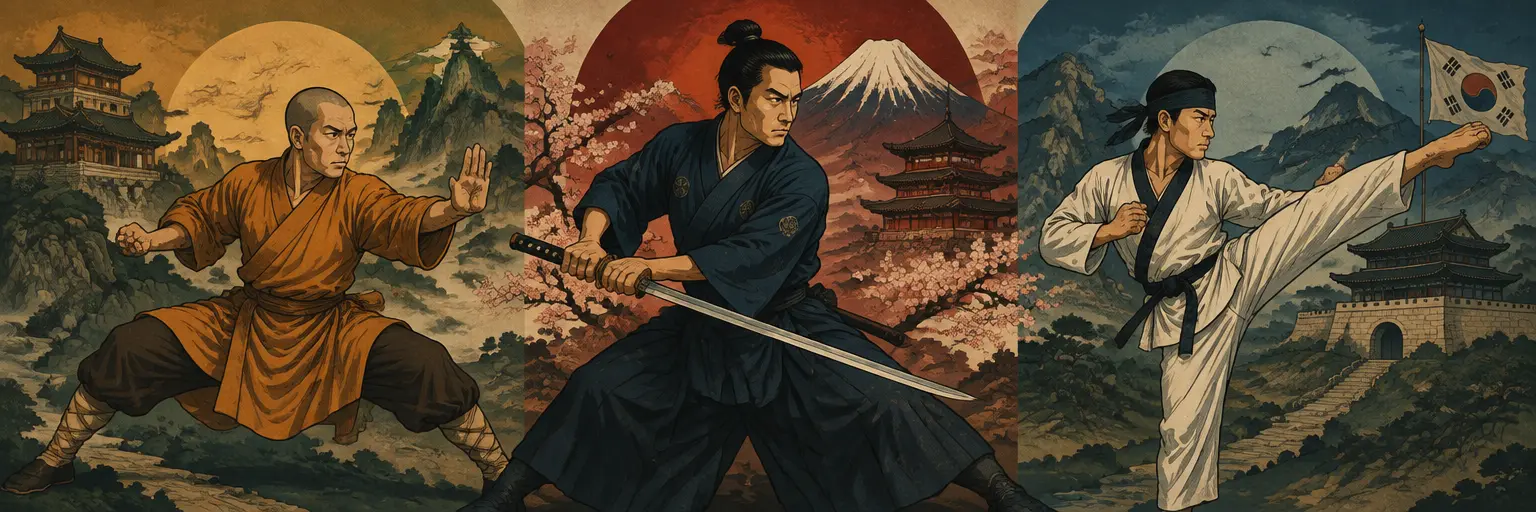
Dive into the rich tapestry of Asian martial arts and trace their profound evolution across China, Japan, and Korea—three nations whose combat traditions have shaped global fighting philosophies. From the ancient Shaolin temples of China, where Kung Fu merged spirituality with self-defense, to the disciplined samurai era of Japan that birthed Judo, Karate, and Aikido, and onward to Korea’s dynamic Taekwondo and Hapkido, this journey reveals how history, culture, and warfare transformed martial practice into living art forms. Explore the cross-pollination of techniques, the rise of modern sport vs. traditional combat, and the philosophical cores that still guide practitioners today. Perfect for history buffs and martial artists alike, this exploration highlights how each nation’s unique social and political climate forged distinct styles—while sharing a common soul of discipline, respect, and self-mastery. Uncover the legendary masters, pivotal battles, and cultural exchanges that continue to influence modern training and self-defense worldwide.
🌟 Discover the fascinating roots of Kung Fu ancient Chinese origins, tracing its evolution from ancient martial traditions to a global martial…
Read article
🗡️ Discover how the Kamakura samurai martial traditions solidified the warrior class's power, shaping Japan's martial culture through disciplined combat techniques, honor…
Read article
🥋 Japanese martial arts dojo culture is the heartbeat of tradition and innovation, nurturing discipline and respect while evolving practices to preserve…
Read article
🌟 The Cultural Revolution profoundly suppressed Chinese martial arts, nearly erasing centuries of tradition. However, the Chinese martial arts revival has sparked…
Read article
🥋 Discover the rich history and philosophy behind Kuk Sool Won, a comprehensive Korean martial art. This article explores Kuk Sool Won…
Read article
😊 Explore the fascinating Taekwondo modernization history, tracing its evolution from a martial art rooted in military discipline to an acclaimed Olympic…
Read article
🥋 Explore how Chinese martial arts profoundly shaped early Korean combat systems, illustrating the deep cultural exchange and shared techniques that continue…
Read articleDiscover how the martial arts of China, Japan, and Korea evolved from ancient battlefield techniques into global systems of self-defense, sport, and spiritual growth. This subcategory unpacks the historical cross-pollination, cultural shifts, and legendary masters that shaped karate, kung fu, taekwondo, judo, and more—offering context that deepens your practice and appreciation.
China is the cradle of Asian martial arts, with records of wrestling and spear techniques dating back over 4,000 years. The Shaolin Temple (circa 5th century) fused Buddhist meditation with combat, giving birth to Shaolin Kung Fu—a system emphasizing explosive strikes, acrobatic kicks, and animal-inspired forms. Over centuries, this branched into hundreds of styles, from Wing Chun’s close-range efficiency to Northern Long Fist’s wide, powerful movements.
Simultaneously, China developed internal martial arts like Taijiquan, Baguazhang, and Xingyiquan, which prioritize softness, breath control, and intent over brute force. These practices were formalized by figures like Zhang Sanfeng (legendary Daoist) and later systematized for health and meditation. For practitioners, understanding China’s contribution means appreciating the diversity of combat logic—from hard external styles to soft internal ones—each with unique biomechanics and philosophical goals.
Japan transformed imported Chinese concepts into highly codified martial systems under the samurai class. Jujutsu, developed for armored combat, emphasized joint locks, throws, and pins—techniques later refined into Judo (1882) by Jigoro Kano, who stripped away lethal moves to create a modern sport. Meanwhile, Karate traveled from Okinawa, blending indigenous grappling with Chinese kung fu striking, then became a symbol of Japanese discipline after annexation in 1879.
The Bushidō code—loyalty, honor, and self-control—permeates Japanese arts, visible in rituals like bowing and kata (prearranged forms). Aikido, founded by Morihei Ueshiba, added a spiritual dimension, redirecting an attacker’s energy without harming them. For learners, Japan offers a structured pedagogy with belt ranks and clear progressions, making it ideal for systematic practice—yet its history is also a study in how martial arts adapt to peace-time society and national identity.
Korea’s martial heritage combines indigenous traditions with Chinese and Japanese influences, resulting in explosive, dynamic techniques. Taekwondo, officially established in 1955, is the most famous—a sport and Olympic discipline centered on high-speed kicking, emphasizing flexibility, agility, and breaking techniques. Its predecessor, Taekkyon, a fluid folk martial art, influenced its footwork, while Japanese karate contributed forms and stances during the occupation era.
Hapkido (founded 1950s) offers a more circular approach, combining joint locks, pressure points, and kicks, often described as “the Korean Aikido” but with harder striking. The Korean military’s push to unify civilian martial arts under the Taekwondo brand highlights the role of nationalism in martial evolution. Practitioners benefit from Korea’s competitive infrastructure—structured sparring, poomsae (forms), and Olympic pathways—while also learning the profound mudochongshin (martial spirit) that values honor and tenacity.
Asia’s martial arts never developed in isolation. China supplied foundational principles—striking, grappling, and meditation—which Japan and Korea adapted to their own geographies and social structures. Japan’s feudal island environment encouraged efficient killing techniques for samurai, while Korea’s mountainous terrain and frequent invasions favored mobility and surprise (e.g., Taekwondo’s jumping kicks). The 20th-century occupations (Japanese rule over Korea, 1910–1945) forced cultural exchanges that merged styles, yet also sparked deliberate differentiation.
Today, this history explains why karate looks different from kung fu despite shared ancestry—and why taekwondo scores points for head kicks while judo bans striking. For modern martial artists, understanding cross-pollination prevents dogmatic “my style is best” thinking, encouraging respect and technical cross-training. It also clarifies how politics, war, and identity shape even the most “ancient” arts, making them living systems rather than frozen relics.
Beyond combat, Asian martial arts carry profound philosophical underpinnings—from Daoism’s flow (Wu Wei) in Taijiquan to Zen Buddhism’s stillness in Japanese swordsmanship and Confucianism’s hierarchy in Korean dojang etiquette. Training is not only physical but character-building: discipline, patience, humility, and self-mastery are core goals. Kata and poomsae are moving meditations, preserving hidden combat applications while cultivating focus.
Each culture interprets the “ultimate goal” differently: Chinese arts often seek harmony with nature, Japanese arts emphasize perfecting the self through rigorous ritual, and Korean arts stress community and spirited perseverance (we’re all family in the dojang). For practitioners, this subcategory provides a lens to see beyond athleticism—transforming every punch or kick into a lesson about mindfulness, ethics, and personal growth. It also validates that martial arts are not just fighting but a lifelong path toward balance.
China’s martial arts are the oldest, with archaeological evidence of wrestling-like activities dating to 2000 BCE. The Shaolin Temple codified its kung fu around the 5th–7th centuries CE. Japan’s jujutsu evolved later, and Korea’s taekwondo as a formal art emerged only in the 1950s, though its roots like Taekkyon go back centuries.
Karate originated in Okinawa, blending indigenous martial arts with Chinese kung fu, then was formalized by Japan’s Ministry of Education in the 1920s–30s. Taekwondo was synthesized in the 1950s by Korean generals who mixed Taekkyon, karate’s striking, and Chinese footwork, then promoted it as a national sport to foster identity.
Yes, but effectiveness depends on the style and training method. Wing Chun and Bak Mei are practical for close-quarters combat, while Taijiquan requires years of internal development. However, many schools emphasize forms over sparring, so self-defense readiness improves with pressure-testing against resisting partners.
High kicks stem from Taekwondo’s Olympic scoring (head kicks earn more points) and its cultural branding as dynamic and spectacular—a deliberate contrast to Japanese arts. Historically, Korean warriors used low kicks, but the 20th-century sportification plus media influence popularized flashy, high-impact techniques for display and competition.
Absolutely, and many modern practitioners do. Cross-training is beneficial, but start with one core art (e.g., judo for throws, karate for striking, taekwondo for kicking) before adding others. Each art has distinct footwork and body mechanics, so avoid mixing too early. Focus on foundational movement, then integrate complementary skills for rounded self-defense.